The Perfect Evening Routine: 10 Habits for Better Sleep and Productivity
Your morning is built the night before. Science-backed evening habits - from the Baylor sleep study to Harvard blue light research - that improve sleep quality and reduce anxiety.
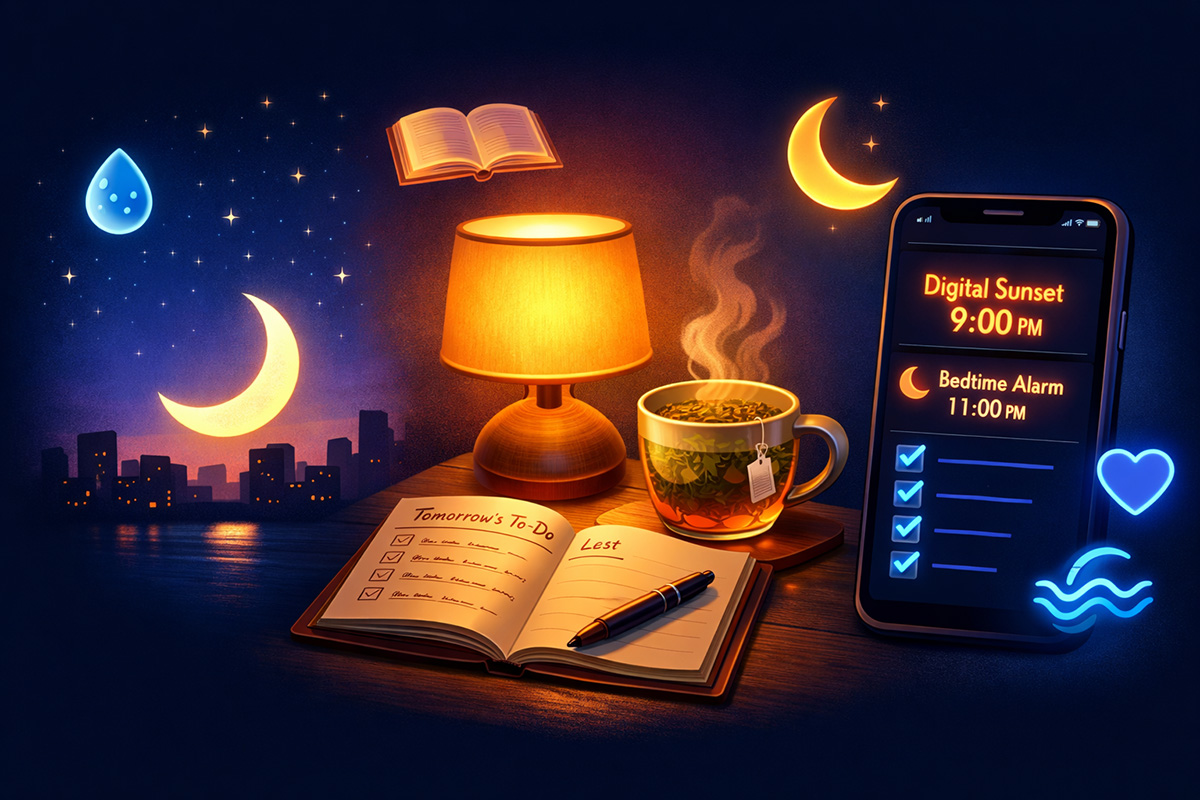
Most productivity advice focuses on the morning. Wake up at 5 AM. Cold shower. Journaling. Exercise. And while a strong morning routine genuinely matters, it misses something fundamental: your morning is built the night before.
The quality of your sleep, the clarity of your first hour, your stress levels before the first email arrives - all of these are downstream consequences of what you do (or don't do) in the hours before bed. Yet only 34% of Americans go to bed at the same time each night, according to a 2023 American Academy of Sleep Medicine survey of 2,005 adults. Meanwhile, 61.7% use social media most or all nights before sleeping.
The evening routine gap is one of the most significant and most fixable performance deficits hiding in plain sight. This article covers the science and the practical habits - what actually works, why it works, and how to build a routine that genuinely transforms your mornings, your sleep, and your days.
Why Your Evening Routine Is the Most Underrated Productivity Tool
Sleep is regulated by two interlocking systems. The first is your circadian clock - the 24-hour internal timer governed by the suprachiasmatic nucleus in your hypothalamus, which coordinates the release of melatonin and the natural drop in core body temperature each evening. The second is homeostatic sleep pressure: adenosine, a byproduct of neural activity, accumulates throughout the day, creating mounting urgency to sleep. The longer you're awake, the more adenosine builds.
Your evening routine either supports these systems or works against them. Stress, bright screens, stimulating content, and unfinished mental business all elevate cortisol - the hormone that runs opposite to melatonin - delaying your sleep onset and fragmenting your sleep architecture. The result isn't just tiredness. It's measurable cognitive impairment, emotional dysregulation, and a 60% amplification in amygdala reactivity the following day, according to research published in Current Biology.
In contrast, the National Sleep Foundation's 2025 Sleep in America Poll found that nearly 88% of adults who report good sleep satisfaction also report "flourishing" in overall well-being. The evening routine is the mechanism that bridges intent and outcome.
The Digital Sunset: What Blue Light Actually Does to Your Brain
In 1879, Thomas Edison extended the human day with artificial light. In 2007, the iPhone extended it further into a permanently illuminated, infinitely stimulating pocket device. The biological cost has been significant.
Harvard researchers compared 6.5 hours of exposure to blue light versus green light of comparable brightness. The findings were stark: blue light suppressed melatonin for twice as long as green light and shifted circadian rhythms by three hours versus one and a half hours. Separate research found that reading a light-emitting eReader before bed (compared to a printed book) delayed melatonin onset by 1.5 hours, reduced REM sleep, and caused significantly greater morning sleepiness - published in a landmark 2015 PubMed study (PMID 25535358).
The cumulative effect: two hours of screen use before bed suppresses melatonin by up to 50%. That's not a small adjustment to your sleep timing - it's a physiological delay that compounds across every night of the week.
The Digital Sunset Rule
Harvard Health recommends avoiding bright screens 2–3 hours before bed. This doesn't mean you can't use devices, but it does mean building a "digital sunset" - a specific time each evening when you transition away from screens toward lower-stimulation activities.
In practice, this looks like: setting your phone to warm-toned Night Mode or Do Not Disturb by 9 PM (if you sleep at 11 PM), switching from social media scrolling to reading physical books or doing light stretching, and using the evening hours for activities that don't involve a glowing rectangle held six inches from your face.
Setting a specific "digital sunset" reminder in your app each evening eliminates the need for willpower at the moment when your prefrontal cortex is already fatigued. The decision is made in advance.
The Science of Planning Tomorrow Tonight
One of the most counterintuitive findings in sleep research is that writing a to-do list before bed can dramatically accelerate sleep onset. Not journaling about the past. Not gratitude for what happened today. Writing down what you need to do tomorrow.
The Baylor University Study
In a study published in the Journal of Experimental Psychology: General (January 2018), researcher Michael K. Scullin, PhD and colleagues at Baylor University recruited 57 healthy young adults and brought them into a sleep laboratory. Participants spent five minutes writing before monitored sleep - half wrote a detailed to-do list for the coming days, half wrote about completed activities from the past days.
The results were striking. Those who wrote specific, detailed to-do lists fell asleep in an average of 16 minutes, compared to 25 minutes for those who wrote about completed tasks - a nine-minute improvement. More importantly, the more specific and detailed the to-do list, the faster participants fell asleep. Writing about the past had the opposite effect.
The mechanism connects to the Zeigarnik Effect - the psychological phenomenon, first described by Soviet psychologist Bluma Zeigarnik, whereby incomplete tasks occupy disproportionate mental bandwidth until resolved. Research by Baumeister and Masicampo (2011) in the Journal of Personality and Social Psychology established that you don't need to complete a task to silence its mental intrusion - you simply need to make a concrete plan for it. The brain accepts a specific plan as a psychological promise of completion, releasing the cognitive tension that was keeping you awake.
Implementation Intentions
Peter Gollwitzer's research at NYU on "implementation intentions" adds another layer. When you pre-specify exactly when, where, and how you'll perform a task - "If it's 9 AM and I've made coffee, I'll open the presentation file immediately" - goal achievement increases dramatically. A meta-analysis of 94 studies found implementation intentions had a medium-to-large effect on goal attainment (d = .65). Setting specific alarms and reminders the night before is a practical application of this principle: you're not just planning, you're pre-committing.
Reviewing tomorrow's schedule and setting specific time-blocked reminders each night converts vague intentions into concrete, time-anchored commitments - before the cognitive fatigue and decision demands of the next day begin.
The Shutdown Ritual: How to Mentally Leave Work Behind
Cal Newport, computer science professor at Georgetown University and author of Deep Work, describes the "shutdown ritual" - a fixed end-of-workday sequence that psychologically closes the workday. It typically involves reviewing incomplete tasks, capturing anything unfinished in a trusted system, planning the next day, and ending with a deliberate verbal phrase ("Shutdown complete") as a psychological termination cue.
The science behind this ritual comes from the work of Professor Sabine Sonnentag at the University of Mannheim, whose research established that psychological detachment from work during off-hours is one of the strongest predictors of well-being, recovery, and next-day engagement. In a landmark day-level study (Sonnentag, Binnewies, and Mojza, 2008, published in the Journal of Applied Psychology), survey data from 166 public administration employees across one work week found that low psychological detachment during evenings predicted fatigue and negative mood the following morning - while mastery experiences and relaxation predicted positive next-day energy.
The paradox: you become more productive at work by being more genuinely absent from it during your recovery time. The shutdown ritual makes this possible by giving the brain a clear signal: the open loops have been captured and scheduled. You can stop processing them now.
Newport documented his own experience: within less than a month of practicing the shutdown ritual, "the urge to check email or think about work in the evenings had become essentially non-existent."
A Simple Shutdown Sequence
- Review any loose notes or unfinished tasks from the day
- Check tomorrow's calendar and confirm your plan
- Set any necessary reminders for tomorrow morning
- Declare shutdown - say it out loud if needed
- Close work apps and switch to evening mode
The Warm Bath Trick (It Really Is Science)
Here is one of the most solidly evidence-backed sleep recommendations that most people haven't heard of: a 10-minute warm bath or shower taken one to two hours before bed shortens sleep onset latency by approximately 36%.
This finding comes from a 2019 systematic review and meta-analysis led by researchers at the University of Texas at Austin, analyzing 17 studies across 5,322 candidate articles, published in Sleep Medicine Reviews (PubMed ID 31102877). The optimal parameters: water temperature of 40–42.5°C (104–109°F), duration of at least 10 minutes, taken 1–2 hours before target bedtime.
The mechanism is elegant. Falling asleep requires a drop in core body temperature. Warm water draws blood to peripheral vessels (hands and feet), accelerating the natural heat dissipation the body needs to initiate sleep - a process called the distal-proximal skin temperature gradient. In essence, the bath does the temperature work for you.
The 1–2 hour window matters. A bath immediately before bed can temporarily raise core temperature and delay sleep. The right timing allows the post-bath cooling effect to align with your target sleep onset.
Gratitude Journaling Before Bed: What the Research Shows
Not all journaling before bed is equal. While the Scullin study shows that forward-looking to-do lists accelerate sleep onset, writing about the past evening (ruminating about the day's stresses) can worsen sleep. Gratitude journaling occupies a specific and well-studied middle ground.
Alex M. Wood and colleagues at the University of Manchester published a study in the Journal of Psychosomatic Research (2009, PubMed ID 19073292), examining 401 community participants across a range of ages. They found that gratitude predicted:
- Greater subjective sleep quality
- Longer sleep duration
- Lower sleep latency (less time to fall asleep)
- Less daytime dysfunction
The pathway was specific: gratitude reduced negative pre-sleep cognitions (worrying, ruminating) and increased positive pre-sleep cognitions. This was the first study to demonstrate that a positive personality trait predicts sleep quality above and beyond other personality factors - and that the mechanism is the content of your thoughts in the moments before sleep.
In practice, this means that five minutes of writing down three specific things you're grateful for - not generic ones like "my family and health," but particular moments from the day - shifts the emotional texture of your pre-sleep mental state from threat-detection to contentment.
SparkDay's journal lets you do exactly this: capture mood, write brief notes, and log the emotional texture of your day before bed - creating a record that becomes genuinely useful as a pattern-detection tool over weeks and months.
Your 10-Habit Evening Routine, Step by Step
The following sequence synthesizes everything above into a practical 60–90 minute routine, beginning 90 minutes before your target bedtime. Adapt the specific habits to your life, but preserve the underlying structure - it's what the research supports.
T-90 minutes: The Shutdown Ritual (10 minutes)
Habit 1: Close your workday deliberately. Run your shutdown sequence: review tomorrow's calendar, capture any open loops, set your morning reminders, and close work apps. Declare the workday over - out loud, if it helps. This is Sonnentag's psychological detachment, engineered into a daily practice.
T-80 minutes: Body Reset (15–20 minutes)
Habit 2: Take a warm shower or bath. Water at 40–42°C for at least 10 minutes. This is the 36% sleep onset improvement from the UT Austin meta-analysis. It also serves as a physical transition ritual - the shower marks the shift from day-mode to rest-mode.
T-60 minutes: The Digital Sunset (ongoing)
Habit 3: Put screens away. This is when your phone goes face-down, social media closes, and the TV goes off. Set a recurring reminder or alarm for this - it removes the friction of having to decide. The melatonin suppression from blue light peaks when screens are used right up to bedtime.
T-55 minutes: Light Movement (10 minutes)
Habit 4: Gentle stretching or a short walk. Research consistently shows moderate-intensity exercise done 90+ minutes before bed does not harm sleep - and often improves it. Evening walks have the additional benefit of exposure to natural evening light, which supports the melatonin transition. If you haven't hit your daily step goal, a 10-minute evening walk is the easiest fix.
T-45 minutes: Tomorrow Planning (10 minutes)
Habit 5: Review and set tomorrow's schedule. Open your planner and look at tomorrow's time blocks. Are the most important tasks scheduled to specific times? Are your reminders set? Write a brief to-do list for tomorrow - this is the Scullin finding in action. The more specific your list, the faster you'll fall asleep. Do this on paper or in your planning app.
T-35 minutes: Prepare Your Environment (5 minutes)
Habit 6: Set up for tomorrow morning. Lay out what you need for the morning - workout clothes, work bag, coffee prep. Research on "friction reduction" (James Clear, Atomic Habits) shows that pre-staging your environment dramatically lowers the activation energy needed for next-morning behaviors. Combined with your implementation intentions from Habit 5, this makes tomorrow's good habits nearly effortless.
T-30 minutes: Wind-Down Reading (20 minutes)
Habit 7: Read a physical book. Not a screen, not a tablet - paper. Reading a print book before bed is associated with lower pre-sleep arousal and better sleep quality compared to reading on a light-emitting device (the 2015 study that found eReaders delayed melatonin by 1.5 hours also confirmed that print readers fell asleep faster and experienced more restorative sleep). Fiction tends to be more cognitively absorbing than non-fiction for wind-down purposes, since it shifts mental focus away from real-world concerns.
T-10 minutes: Gratitude and Reflection (5 minutes)
Habit 8: Write three specific things you're grateful for. Keep it specific: not "I'm grateful for my family" but "I'm grateful for the 30 minutes my daughter and I spent talking about her school project." Specificity is what produces the mood shift and the pre-sleep cognitive reframe that Wood's research documented.
T-5 minutes: Sleep Environment Check (2 minutes)
Habit 9: Optimize your sleep environment. Darkness (blackout curtains or sleep mask), coolness (65–68°F / 18–20°C is the research-backed optimal room temperature for sleep onset), and quiet (or consistent white noise to mask variable sounds). Your bedroom temperature directly affects the core body temperature drop needed to initiate sleep.
T-0: Consistent Bedtime
Habit 10: Go to bed at the same time every night. Sleep regularity - consistent bed and wake times within a narrow window - is independently associated with better metabolic, cardiovascular, and mental health outcomes, according to the National Sleep Foundation's consensus statement in the Sleep Health Journal (2023). Sleep consistency synchronizes your circadian clock and reduces sleep latency over time. If you only implement one change from this article, this is the one with the broadest downstream benefits.
How to Start Tonight
You don't need to implement all ten habits simultaneously. Research on habit formation is clear: stacking too many changes at once dramatically increases the failure rate. The better approach is to anchor one or two habits to an existing evening behavior and add from there.
Here's a minimum viable evening routine for your first week:
- Pick a consistent bedtime - and work backwards 90 minutes to set your "routine start" time
- Set a phone alarm for your digital sunset - 60 minutes before bed
- Write tomorrow's to-do list - three to five specific tasks, with times if possible
- Write three specific gratitudes - immediately before turning the light off
These four habits take less than 15 minutes, require no equipment, and hit the four highest-impact levers the research identifies: sleep timing consistency, blue light reduction, pre-sleep planning (Scullin), and pre-sleep positive cognitions (Wood).
The morning you've been trying to build through willpower and alarm clocks and motivational quotes is actually built here - in the quiet of the evening, in habits small enough to actually do.
SparkDay was designed for exactly this: scheduling your wind-down habits on the visual timeline, setting smart reminders for your digital sunset and bedtime, logging your mood and gratitude in the journal, and checking tomorrow's plan before you close your eyes. See how it compares to other daily planner apps. The system doesn't require discipline. It requires one decision - to build the routine - and then the routine does the rest.
Frequently Asked Questions
What time should I start my evening routine?
Most sleep researchers recommend starting your wind-down routine 60-90 minutes before your target bedtime. If you want to be asleep by 10:30 PM, start your routine by 9:00 PM. This gives your body enough time to lower cortisol, reduce core temperature, and build melatonin.
How long should an evening routine be?
30-60 minutes is ideal. Shorter routines may not give your body enough time to transition from alert to sleepy. Longer routines risk feeling like a chore. Start with 3-4 habits that take about 30 minutes total and expand if needed.
Should I avoid screens before bed?
Harvard research shows blue light from screens suppresses melatonin production by up to 50% and delays sleep onset. Ideally, stop screen use 60 minutes before bed. If that's not realistic, use night mode or blue light filters and avoid stimulating content (social media, news, work email) in the last hour.
Is it bad to eat before bed?
Heavy meals within 2-3 hours of bedtime can disrupt sleep quality. However, a light snack containing tryptophan (warm milk, turkey, bananas, or nuts) can actually promote sleep. The key is avoiding large, high-fat, or spicy meals close to bedtime while not going to bed hungry.
What if my partner has a different schedule?
Focus on the elements you can control individually: your screen cutoff time, journaling, and wind-down activities. Use headphones for sleep sounds or meditation. The planning-for-tomorrow step can be done at any time. Many couples find that even doing 2-3 evening routine habits independently improves their sleep.
Ready to Take Control of Your Day?
SparkDay combines daily planning, step tracking, habit building, and focus timers in one free app.