Step Challenge With Friends: The Fitness Hack That Actually Sticks (Science)
A Penn RCT found competition produced 90% more exercise attendance than social support. A Nature study of 1.1M runners proved exercise is causally contagious. The behavioral science of friend step challenges.
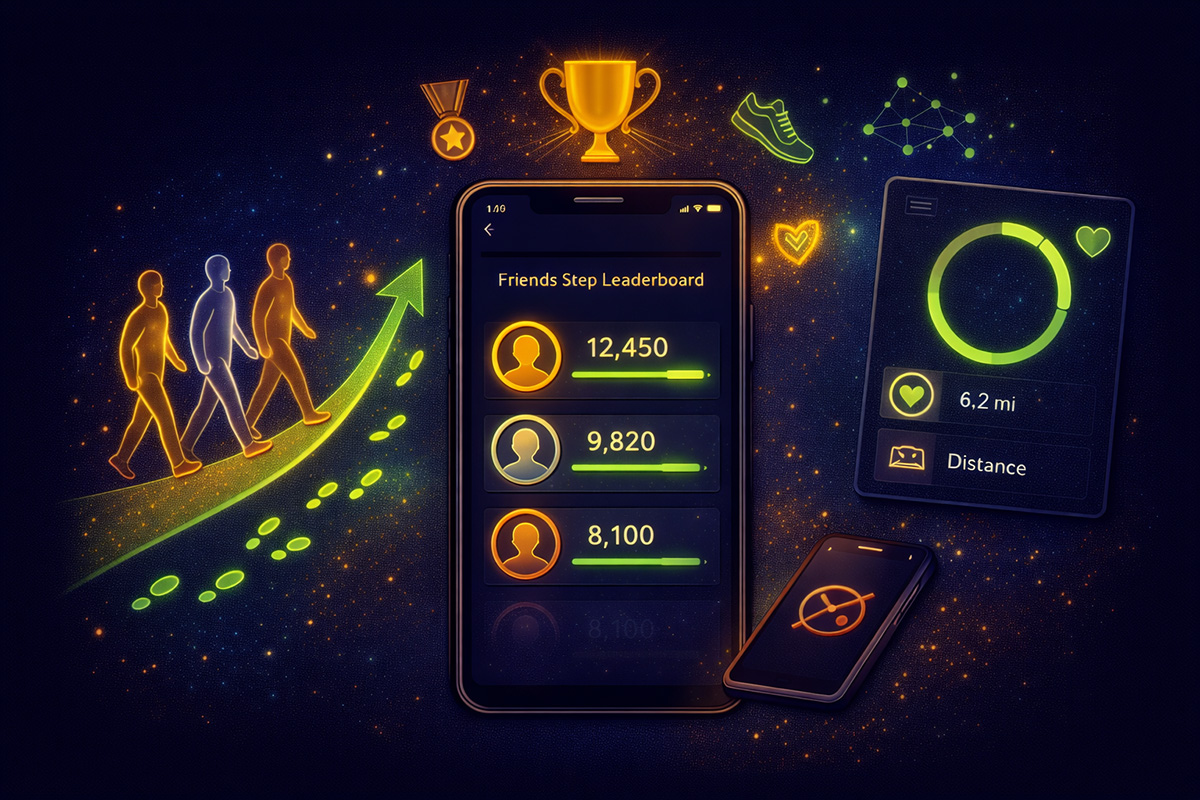
Fitness apps have a retention catastrophe. Average 30-day retention for fitness apps: 7.88%. Day one, roughly one in three new users are still active. By day thirty, fewer than one in thirteen remain.
The reasons are predictable: novelty fades, abstract goals feel disconnected from daily identity, and missing a workout has no social consequence. Solo tracking is quiet. There's nobody watching, nobody to let down, nobody to chase.
But there is a consistent exception to this pattern. Apps and programs that incorporate social features - leaderboards, challenges, friend comparisons - retain users at rates 30% higher than their solo-tracking counterparts. Community-driven elements create network effects: leaving the app means losing the social connection, not just the tracking tool.
This isn't a feature preference. It's a reflection of deep behavioral science. The research on social competition, exercise contagion, dopamine signaling, and accountability partners converges on a single conclusion: competing with friends on daily steps is one of the most biologically and psychologically sound fitness strategies available to the average person.
Here's why, with the studies to prove it.
Why Solo Fitness Habits Are So Hard to Maintain
The behavioral science of habit formation identifies three requirements for a behavior to become automatic: a cue, a routine, and a reward. Solo fitness fails most often at the reward stage - the neurochemical payoff for exercise is real (endorphins, serotonin, dopamine) but delayed, diffuse, and easy to rationalize away when motivation is low.
Self-Determination Theory, developed by Edward Deci and Richard Ryan, identifies three basic psychological needs that must be satisfied for intrinsic motivation to develop: competence (feeling skilled), relatedness (feeling connected to others), and autonomy (feeling self-directed). Solo fitness satisfies autonomy easily and competence over time - but almost never satisfies relatedness. The missing social dimension is not a nice-to-have. It's one of three foundational requirements for sustained motivation.
The data on why people quit exercise programs confirms this. The number one cited reason: lack of accountability and social support. Not lack of time. Not lack of equipment. Lack of someone who notices whether you showed up.
The Penn Study: Competition Beats Support by 90%
The most significant direct experiment on social formats in exercise comes from the University of Pennsylvania's Annenberg School. Researcher Jingwen Zhang and professor Damon Centola recruited 800 Penn graduate students for an 11-week exercise intervention involving 90+ exercise classes. Participants were randomly assigned to one of four conditions: individual competition, team competition, team social support, or control group.
The results, published in Preventive Medicine Reports, were striking:
- Individual competition: 35.7 classes attended per week
- Team competition: 38.5 classes per week
- Control group: 20.3 classes per week
- Team social support: only 16.8 classes per week - less than the control group
Competition attendance was 90% higher than the control group. Pure social support was actually worse than doing nothing in terms of exercise adherence.
The reason pure support underperformed: social support groups can inadvertently draw attention to less active members, creating a negative social spiral where the group's norm becomes low participation rather than high. Competition creates a different dynamic entirely - it makes activity the standard, and falling below the standard has social stakes.
A separate study from the University of Oregon confirmed that competitive apps outperformed cooperative apps in raw activity increases, though cooperative apps were more effective for self-reported life satisfaction. The practical implication: for actually moving more, competition works. For feeling good about yourself while moving the same amount, cooperation works.
Exercise Is Literally Contagious (Nature Study)
In 2017, Sinan Aral (MIT Sloan) and Christos Nicolaides (MIT) published one of the most elegant studies in behavioral science in Nature Communications. They analyzed 1.1 million runners who ran over 350 million kilometers across five years in a global fitness social network - combined with daily weather data for 1,000+ cities as a natural experiment.
The weather data was the key methodological innovation: rainy days create exogenous shocks to exercise behavior (people exercise less when it rains). By tracking how one person's rain-day drop in running affected their friends' running, the researchers could isolate true causal social influence from the alternative explanation that people who exercise together are simply similar (homophily).
The findings:
- Exercise is causally socially contagious - not just correlated
- An extra 1 km run by a friend inspires you to run an extra 0.3 km
- An extra 10 minutes of running by a friend inspires 3 more minutes from you
- Asymmetric influence: Less active runners influence more active runners - if a previously sedentary friend starts running, an already-active person runs more
- Gender asymmetry: Men are influenced by both male and female friends; women are influenced primarily by female friends
The Aral and Nicolaides finding is important because it establishes the mechanism as causal, not correlational. You don't just happen to exercise more when your friends do. Your friends' activity is actively causing yours.
The Christakis-Fowler "Three Degrees" Effect
Nicholas Christakis and James Fowler established the broader principle of social contagion in their research on social networks (published in Statistics in Medicine, 2013). Health behaviors - including obesity, smoking, happiness, and exercise - spread through social networks up to three degrees of separation: your friend's friend's friend can influence your behavior through the network.
Damon Centola, whose exercise competition research we cited above, further established in his book How Behavior Spreads that strong ties (close friends, coworkers) are more powerful for spreading complex health behaviors than weak ties. Complex behaviors like exercise require social reinforcement from multiple trusted sources - exposure alone isn't enough. This is why a step challenge works better with five close friends than with 500 social media followers.
The Dopamine-Social Reward Loop
Exercise releases dopamine, serotonin, and endorphins - the neurochemical foundation of what's sometimes called the "runner's high." Social interaction activates the brain's mesolimbic dopamine system in a structurally similar way. Research published in PMC (2010, "The Rewarding Nature of Social Interactions") confirmed that social interactions are intrinsically rewarding, activating dopaminergic pathways in the nucleus accumbens and striatum - the same reward circuitry engaged by exercise.
When you compete on steps with friends, you combine two independent dopamine sources: the neurochemical reward of physical activity and the social reward of competition, progress, and recognition. Research in Nature Communications (2024) found that dopamine builds and reinforces reward-associated behavioral patterns - essentially, checking the leaderboard and seeing yourself ranked higher becomes self-reinforcing. The social-competitive element is not a gimmick layered on top of exercise tracking. It is a second dopamine pathway that compounds the first.
The Strava Effect
Strava's 2024 Year in Sport report provides large-scale behavioral data confirming the social-exercise connection:
- Runners are 83% more likely to achieve a personal record in a group versus solo
- 40% average increase in activity length when exercising with 10+ people versus alone
- Running clubs grew 59% in 2024; walking clubs grew 52%
- 77% of Gen Z athletes feel more connected when they can see friends' activities
- 58% of respondents (and 66% of Gen Z) made new friends through a fitness group in 2024
A separate study analyzing Strava network data, published in ScienceDirect (2022), found that receiving "kudos" (social validation) caused runners to run more frequently and farther. Athletes adjusted their running behavior to match that of their kudos-giving friends. Social recognition is not just a feel-good feature - it is a behavioral modifier with measurable magnitude.
What Step Challenges Actually Do to Your Health
Setting aside the motivation science, the health case for step challenges is grounded in robust epidemiological data.
A 2025 systematic review and dose-response meta-analysis published in The Lancet Public Health - the most comprehensive such analysis to date - established the following:
- 7,000 steps per day is associated with 25% lower cardiovascular disease risk versus 2,000 steps per day
- 7,000 steps per day is associated with 47% lower all-cause mortality risk versus 2,000 steps per day
- Every 1,000-step increment reduces all-cause mortality by approximately 15%
- Every 500-step increment reduces cardiovascular mortality by 7%
- The optimal daily step target for all-cause mortality: approximately 8,800 steps
Harvard Health confirmed: just 7,000 daily steps reduces heart disease risk. The European Society of Cardiology's "World's Largest Study" found that the dose-response is linear from near-zero activity - meaning any competitive step challenge creates measurable health benefit, regardless of starting point.
Steps and Mental Health
A 2024 meta-analysis published in JAMA Network Open (33 studies, approximately 100,000 adults) found:
- 5,000+ steps per day: fewer depressive symptoms
- 7,500+ steps per day: 42% lower prevalence of depression diagnosis
- Every 1,000-step increase: 9% reduction in depression risk
A landmark study published in The Lancet Psychiatry (2018), analyzing 1.2 million Americans (Chekroud et al.), found that people who exercise regularly report 1.5 fewer poor mental health days per month. Team sports showed the largest mental health association (22.3% lower burden) - which is the closest analog to a friend-based step challenge in large-scale mental health research.
What Step Challenges Specifically Produce
The clinical research on step-count monitoring interventions is consistent:
- Springer Nature meta-analysis (2020, 32 studies): +1,126 steps per day at four months; +464 steps at one year
- Annals of Family Medicine meta-analysis: pedometer use associated with an average +2,000 steps per day compared to non-pedometer groups
- SAGE Journals 2025 systematic review (children and adolescents, 34 studies): step-monitoring interventions increased daily steps by an average of +1,588 steps per day
An additional 1,000–2,000 steps per day - what the research consistently shows from step monitoring alone - represents a 9–15% reduction in all-cause mortality risk, per the Lancet 2025 dose-response data. The health math on step challenges is straightforward.
Leaderboard Psychology: Why Proximity Motivates
Not all leaderboard designs are equally motivating. Research on the psychology of competitive ranking reveals a specific pattern: motivation is highest when you are just below a reachable target.
Being ranked second is more motivating than being ranked first or last. Being 500 steps behind the leader is more motivating than being 5,000 steps behind. Research on social comparison in fitness apps (JMIR Human Factors, 2023) found that users more frequently chose upward comparison targets - people with more steps - than downward ones. But the motivation effect was strongest when the gap was bridgeable: moderate upward comparison drives motivation, while extreme gaps cause disengagement.
A related phenomenon documented in leaderboard research: mid-tier performers gain the most from competition. The person in third place, chasing second, is in the highest-motivation position. The person in first place experiences less benefit from the competitive structure (no one to chase) - and the person in last place may disengage if the gap feels insurmountable.
This is why friend-based challenges work better than large public leaderboards. With five to eight friends, the gaps are naturally smaller and more bridgeable, keeping everyone in the high-motivation zone.
The Gamification Warning
Research from Frontiers in Psychology (2025) found an S-shaped impact of gamification feature richness - too many simultaneous mechanics leads to "gamification burnout" and app abandonment. The optimal design is moderate: clear step counts, a simple ranking, and social recognition. More features aren't always better.
From Extrinsic Start to Intrinsic Habit: The Long Game
The legitimate concern about competitive step challenges is the question of intrinsic motivation: does competing for a leaderboard position undermine long-term exercise habits by replacing internal motivation with external reward?
The research answer is nuanced but clear. Deci's original "undermining effect" finding (1971) - that extrinsic rewards can reduce intrinsic motivation - applies specifically to controlling rewards that remove autonomy. Social competition in a friend group is different: it satisfies all three of Self-Determination Theory's basic psychological needs simultaneously.
- Competence: You feel capable when you climb the leaderboard
- Relatedness: You feel connected to the people you're competing with
- Autonomy: You choose how to reach your steps - route, timing, pace
A 2018 PMC study on intrinsic and extrinsic motives for exercise maintenance found that at 3- and 12-month follow-up, participants with intrinsic feedback conditions reported continuous exercise adherence twice as frequently as the extrinsic-only group. But the conclusion wasn't that extrinsic motivation is bad - it was that extrinsic motivation is better for starting a habit; intrinsic motivation is critical for sustaining it.
The natural arc of a friend-based step challenge maps onto this research precisely. You start competing for the leaderboard. After six to eight weeks, the walking routine becomes habitual and the social connection reinforces it. The motivation shifts from "I want to beat Alex" to "I walk every day with my friends - it's part of who I am." The competition started the habit; the social bond sustains it.
This is exactly what the Aral and Nicolaides Nature data shows at scale across 1.1 million users: the social influence continues to drive behavior well beyond any initial competitive novelty effect.
How to Run a Step Challenge That Actually Sticks
Based on the research, here are the design principles for a friend step challenge that produces lasting behavior change rather than a two-week burst of activity:
Choose the Right Group Size
5–10 participants is the research-supported sweet spot. Large enough that there are always people to chase, small enough that the gaps are bridgeable and the social connection is genuine. Public leaderboards with strangers produce weaker effects than challenges with people you know.
Set a Meaningful Duration
Research on habit formation (Lally, UCL) finds that 66 days is the median for a simple habit to become automatic. A 30-day challenge is better than nothing but sits at the edge of habit formation - 60 or 90 days produces more durable behavioral change. Frame it as "the next three months" rather than "the next month."
Use a Daily Step Goal, Not a Weekly Total
Daily targets create daily accountability loops. Weekly totals allow the rationalization of catch-up days - walking 25,000 steps on Sunday to make up for five sedentary days doesn't produce the health outcomes that daily activity does, and it breaks the habit loop.
Set a Realistic but Aspirational Target
The research establishes that 7,000–8,000 steps per day is both evidence-based for health outcomes and achievable for most adults with modest lifestyle adjustments. 10,000 steps originated from a 1965 Japanese marketing campaign for a pedometer called the "10,000-step meter" (Manpo-kei) - not from medical research. Start at the group's average and aim for 7,000.
Enable Social Recognition
The Strava "kudos" data is clear: social recognition drives more activity. Simple acknowledgment - a reaction, a comment, a mention - produces the social reward signal that reinforces the walking behavior. Build this into how the group communicates.
Track and Review Weekly
A brief weekly check-in - seeing everyone's step totals for the week, discussing patterns, acknowledging milestones - sustains the social engagement that is the core mechanism of the challenge. The competition is the frame; the social connection is the substance.
SparkDay's friend leaderboard is built around exactly this model: daily step tracking via Health Connect (Android) or HealthKit (iOS), a real-time leaderboard showing where you stand among your group, and the social accountability layer that the research consistently identifies as the most durable driver of sustained physical activity.
The 7.88% thirty-day fitness app retention rate is a solo-tracking problem. With friends watching the same leaderboard, the math changes completely.
Ready to Take Control of Your Day?
SparkDay combines daily planning, step tracking, habit building, and focus timers in one free app.