ADHD Productivity Tips: Why a Visual Planner + Focus Timer Changes Everything
Most productivity advice fails ADHD brains. Learn the neuroscience of time blindness, and discover which tools - visual planners, focus timers, habit trackers - are actually backed by ADHD research.
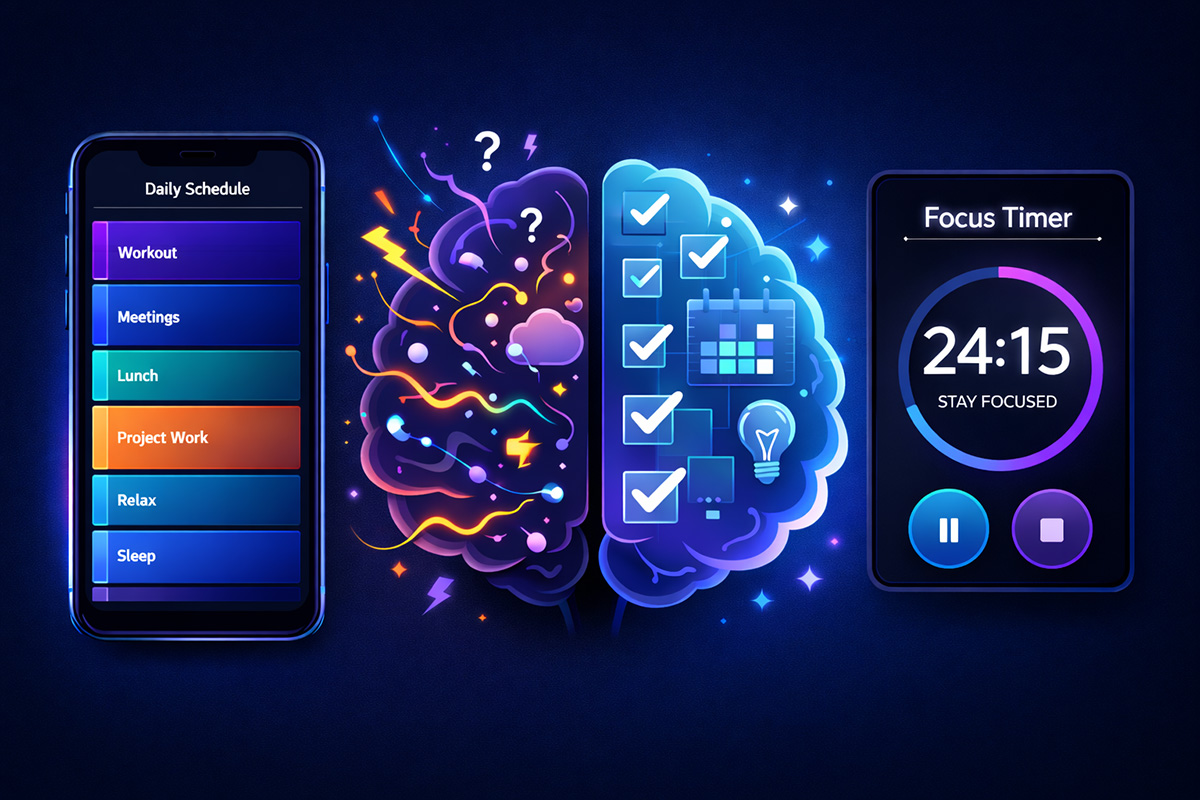
You've read the productivity books. You've bought the planners. You've set the alarms, written the to-do lists, and promised yourself that this week would be different. Then Tuesday rolls around, your day is already three hours behind, and you're deep in a rabbit hole about something completely unrelated to your actual work.
If you have ADHD, this isn't a character flaw. It's neurology. And the reason most productivity advice fails people with ADHD is that it was designed for brains that work completely differently from yours.
ADHD affects approximately 6% of adults in the United States - around 15.5 million people - with rates similarly significant across the globe: roughly 2–6% of adults in Australia and an estimated 3–7% in Singapore, where adult diagnoses are rising sharply as awareness grows. Worldwide, an estimated 3.1% of adults live with ADHD (based on a pooled analysis of over 21 million adults). Yet despite its prevalence, most workplaces, productivity systems, and self-help frameworks are built around neurotypical executive function.
This article is for the ADHD brain specifically - covering the neuroscience of why standard advice falls flat, and which tools (visual planners, focus timers, habit trackers, and step tracking) are genuinely supported by research.
Why Traditional Productivity Advice Fails ADHD Brains
Most productivity systems assume a few things that aren't true for people with ADHD: that you can start a task simply by deciding to, that you have reliable working memory, that you experience time as a continuous flow, and that willpower is a renewable resource you just need to use correctly.
ADHD disrupts executive function - the suite of cognitive skills governed by the prefrontal cortex that handles planning, initiating tasks, holding information in working memory, and regulating impulses. It's not a motivational problem. A 2024 review in Brain Sciences (MDPI) described ADHD as a "chronic disorder of executive functioning" in which the prefrontal cortex struggles to regulate attention and action - even when the person is fully aware of what they should be doing.
The result: advice like "just prioritize better" or "stop procrastinating and start" lands completely differently in an ADHD brain. Without the right scaffolding, the gap between intention and action can feel impossible to bridge - not because of laziness, but because the neurological bridge itself is unreliable.
What actually works for ADHD productivity isn't about more discipline - it's about building external structures that do the work your executive function can't reliably do on its own.
Key insight: ADHD productivity isn't about trying harder. It's about building external systems that compensate for executive dysfunction - visual cues, timers, reminders, and structured routines that remove the need for unreliable willpower.
Time Blindness - The Real Reason You Can't Stick to a Schedule
Dr. Russell Barkley, one of the world's leading ADHD researchers, has argued for decades that ADHD is fundamentally a disorder of time - not just attention. He coined the term time blindness to describe the impaired ability of people with ADHD to sense the passage of time, estimate how long tasks will take, and feel the future as something real and pressing.
Neurologically, this comes down to dopamine. The prefrontal cortex - your brain's planning and time-keeping center - depends heavily on dopamine signaling to track temporal intervals and project into the future. In ADHD, dopamine transmission is dysregulated, making it genuinely harder to feel the difference between "I have an hour" and "I have 10 minutes." A 2024 study published in Scientific Reports found that time discrimination (the ability to tell intervals apart) was measurably impaired in participants with ADHD - and that this improved with targeted brain stimulation targeting the ventromedial and dorsolateral prefrontal cortex.
Time blindness explains several classic ADHD experiences that look like character flaws from the outside:
- Chronic lateness - not because you don't care, but because "leaving in 10 minutes" doesn't feel meaningfully different from "leaving in 45 minutes" until it's urgent.
- Hyperfocus - the inverse of time blindness, where you become so absorbed in a task that 3 hours vanish without notice.
- Task initiation failure - the future deadline doesn't feel real until it's practically now, so starting early requires a level of future-orientation that the ADHD brain struggles to generate.
- Underestimating task duration - classic "planning fallacy" on steroids, because your internal clock runs unreliably.
The fix for time blindness is externalization. You can't rely on an internal clock that doesn't work reliably - so you build external ones. Visible timers, visual schedules that show your whole day at a glance, and structured reminders that bring the future into the present. This is why technology specifically designed around visual and time-based cues makes such a meaningful difference.
Visual Planning: Why Seeing Your Day Changes Everything
For neurotypical people, a simple to-do list can work reasonably well. For ADHD brains, lists often fail - items disappear into an invisible void the moment the list is out of sight. Visual planning addresses this by making your day a spatial, persistent object that you can perceive rather than remember.
A systematic review published in Frontiers in Psychiatry found that visual activity schedule interventions significantly reduced problem behaviors and increased on-task performance in participants with ADHD. The mechanism is clear: visual schedules offload the burden from working memory (which is impaired in ADHD) onto the environment itself. You don't have to remember what's next - you can see it.
Research from occupational therapy practice identifies three specific ways visual schedules support ADHD executive function:
- Working memory support: The schedule holds the information externally so you don't have to hold it in your head.
- Time perception aid: Seeing tasks laid out across hours makes the time horizon concrete and visible - a spatial representation of time that bypasses broken internal clocks.
- Transition support: Clear visual markers for what comes next reduce the anxiety and resistance of task-switching, which is a significant challenge for ADHD brains.
The most effective visual planners for ADHD show a 24-hour timeline rather than a simple list - because seeing your day as a timeline makes time feel real. When you can see that your 2 PM meeting is only 90 minutes away and you have a large empty block that's disappearing, the urgency becomes visual rather than abstract.
Apps like SparkDay are built around exactly this principle - a 24-hour scrollable visual timeline where you can see your activities plotted against the actual hours of your day, rather than a flat list of tasks with no time context. When you can see time being consumed, time blindness has less power over you.
Key insight: To-do lists fail ADHD brains because items become invisible once out of sight. A visual timeline that shows your whole day spatially externalizes time itself - which is the actual problem with ADHD time blindness.
The Focus Timer Technique That Actually Works for ADHD Brains
Getting started is the hardest part for almost every adult with ADHD. Task initiation - the ability to begin working on something without an external trigger - is one of the most impaired executive functions in ADHD. The prospect of "working on this project" for an unspecified amount of time is neurologically overwhelming.
Focus timers work by making the commitment finite and visible. "I will work for 25 minutes, then stop" is a fundamentally different proposition to the ADHD brain than "I need to work on this." The finite window reduces initiation resistance, and the visible countdown creates an external time cue that compensates for time blindness.
A 2020 systematic review in the Journal of Attention Disorders examining 18 studies on time management interventions for ADHD found moderate to strong evidence for techniques involving explicit timeboxing - where work is contained in defined, visible time slots. Workplace accommodation research found that structured break protocols improved job performance evaluations by 22% for employees with ADHD.
The Pomodoro Technique for ADHD
The classic Pomodoro method (25 minutes of focused work, 5-minute break, long break after 4 cycles) is widely recommended for ADHD - but research suggests it works best when adapted. For many ADHD brains, 25 minutes is actually generous; others need the flexibility to extend when they hit a flow state.
Key adaptations that help ADHD specifically:
- Start smaller if 25 minutes feels impossible. A 10-minute timer for a task you've been avoiding is infinitely better than not starting at all. The act of finishing one cycle builds momentum.
- Use a visible countdown, not just an alarm. A timer you can see depleting - rather than one running silently in the background - creates the time pressure cue that helps ADHD brains stay on task. This is the difference between knowing time is passing and feeling it.
- Protect your breaks. ADHD brains are prone to hyperfocus - you may feel like you don't need the break because you're "in it." Take the break anyway. The short break prevents the crash that comes from extended hyperfocus and keeps your focus sessions sustainable.
- One task per session. Multi-tasking during a Pomodoro defeats the purpose entirely for ADHD brains. Write a single task name at the top of your session. Distracting thoughts go on a "parking lot" list, not into action.
SparkDay's built-in focus timer lets you run timed work sessions that appear as visible blocks on your 24-hour timeline - so you can see completed focus sessions alongside your activities. The visual record of work done creates a satisfying feedback loop that the ADHD brain responds well to.
The Reverse Pomodoro for ADHD
For tasks with very high initiation resistance, try reversing the structure: set a 5-minute timer and tell yourself you only have to work for 5 minutes. Almost universally, 5 minutes of starting leads to continued working - because getting started is the actual barrier, not sustaining work. The short initial commitment bypasses the ADHD brain's resistance to large, undefined tasks.
Key insight: The most important feature of a focus timer for ADHD isn't the specific interval - it's visibility. A timer you can see depleting creates an external time cue that compensates for time blindness and sustains attention in a way that a silent background timer cannot.
How Exercise and Step Tracking Boost ADHD Focus
Exercise might be the most underused tool in ADHD management. The neurochemical effects of physical activity on the ADHD brain are substantial - and they work through the same pathways as stimulant medication.
When you exercise, your brain releases dopamine, norepinephrine, and serotonin - the same neurotransmitters that ADHD medications target. A 2025 systematic review and meta-analysis published in the Journal of Global Health (PMC11907377) found that physical activity significantly improved inhibitory control in adults with ADHD - inhibitory control being the ability to stop automatic responses and stay on task. Just 30 minutes of aerobic exercise was found to significantly enhance intracortical inhibition and improve focus.
Multiple recent meta-analyses (published in Frontiers in Psychology in 2024 and 2025) confirm:
- Aerobic exercise significantly reduces symptoms of hyperactivity, impulsivity, and inattention.
- Cognitive-aerobic exercise (where mental demands are combined with movement) shows the greatest improvements in working memory.
- Exercise increases BDNF (brain-derived neurotrophic factor), which supports the growth and connectivity of neurons - improving the very prefrontal circuits most affected by ADHD.
- Benefits begin within a single session - making exercise a same-day tool for focus, not just a long-term health habit.
Dr. John Ratey, Harvard psychiatrist and author of Spark: The Revolutionary New Science of Exercise and the Brain, describes exercise as "like taking a little bit of Prozac and a little bit of Ritalin" for the brain - a comparison that reflects how directly physical activity affects ADHD neurochemistry.
Step Tracking as an ADHD Productivity Tool
You don't need a gym session. Walking 30 minutes, four times a week, delivers meaningful cognitive benefits for ADHD. The challenge is that ADHD brains are notoriously bad at following vague intentions ("I should exercise more"). This is exactly where a daily step tracker becomes useful - not as fitness monitoring, but as an ADHD external cue system.
Seeing your step count at the start of the day creates a concrete, visible goal. The progress toward that goal is quantified and immediate - the ADHD brain responds well to clear, measurable feedback loops. And because step tracking integrates naturally into everyday movement (not just scheduled workouts), it's a lower-resistance entry point into the daily activity that genuinely improves your focus.
SparkDay's step tracker integrates with Apple Health (iOS) and Health Connect (Android) to give you a real-time view of your daily steps alongside your scheduled activities - so you can see the connection between physical movement and your day's productivity, in one place.
Building Habits Without Willpower
One of the cruelest ironies of ADHD is that the brain needs routine more than most, yet building and maintaining routine is one of its greatest struggles. Habits require consistent repetition across time - and the ADHD brain's impulsivity, distractibility, and poor working memory all conspire against this.
The good news: research shows that habit formation for ADHD isn't fundamentally different - it just requires stronger environmental scaffolding and a more forgiving approach to "failure."
Why Willpower Is the Wrong Strategy
Willpower is a limited, depletable resource - and for ADHD brains, it depletes faster due to the constant cognitive overhead of managing executive dysfunction. Building habits through willpower alone is setting yourself up to fail when willpower inevitably runs low (which it does for everyone, ADHD or not).
The more effective approach is environmental design: making the desired behavior the easiest, most obvious, lowest-friction choice, and making undesired behaviors harder to access. Habit research (including work by BJ Fogg at Stanford) shows that behavior change happens most reliably when it's attached to existing cues, not dependent on remembered motivation.
Habit Stacking for ADHD
Habit stacking - attaching a new behavior to an existing reliable habit - is particularly effective for ADHD. The existing habit acts as an automatic cue, removing the initiation problem entirely. Instead of trying to remember to take a new action, you link it to something that already happens on autopilot.
Examples that work well:
- "After I pour my morning coffee, I open my planner and check today's schedule."
- "After I sit at my desk, I set a 25-minute focus timer before opening anything else."
- "After I brush my teeth at night, I mark today's habits as done."
The Role of Habit Trackers
For ADHD specifically, habit trackers serve a dual function: they provide the visual cue to actually do the habit (an external reminder that bypasses working memory), and they create a satisfying, immediate reward for completion that the ADHD brain's dopamine system responds to. Research consistently finds that positive, immediate reinforcement is far more effective for ADHD than delayed rewards or negative self-talk.
CHADD (Children and Adults with ADHD) recommends keeping habits visible, reviewing them daily, and treating missed days with self-compassion rather than shame - because shame triggers avoidance, and avoidance in ADHD is strongly linked to emotional dysregulation, not laziness.
A practical rule: track no more than 3 habits at once. Research on behavior change consistently shows that fewer simultaneous changes produces higher success rates. The ADHD tendency to go all-in and track 12 habits at once is a reliable path to giving up by week two.
Key insight: ADHD habit building succeeds through environmental design and immediate feedback, not willpower. Attach new behaviors to existing cues, keep your tracker visible, and limit active habits to three at a time.
A Sample ADHD-Friendly Daily Routine
What does all this look like in practice? Below is a sample ADHD-friendly daily structure built around the principles covered above - visual planning, focus timers, movement, and low-friction habit tracking. This isn't a rigid prescription; it's a template to adapt based on your own chronotype, work demands, and responsibilities.
Morning Activation Block (7:00 – 8:30 AM)
- 7:00 AM - Wake, no phone for 20 minutes. Checking your phone immediately floods the ADHD brain with stimulation and puts you in reactive mode before you've set your own intentions.
- 7:10 AM - Movement first. Even a 10–15 minute walk before sitting down to work delivers a dopamine boost that improves focus for the next 2–3 hours. Track your steps - this is a cue that today's physical goal is already underway.
- 7:30 AM - Review your visual planner. Open SparkDay (or your tool of choice) and look at the day's timeline. Not to plan - the planning should have been done the night before. This is an activation step: seeing your day concretely makes it real.
- 7:45 AM - Identify your single "must-do" task. The ADHD brain gets overwhelmed by a full to-do list. Identify the one task that, if completed, would make today a success. Schedule it as your first focus session.
First Deep Work Block (8:30 – 10:00 AM)
- Set a visible 25-minute focus timer before opening any communications (email, Slack, messages).
- Work only on your priority task. Keep a notepad next to you for "brain dumps" - intrusive thoughts, other tasks, ideas. Write them down and return to focus.
- After 25 minutes, take a genuine 5-minute break. Stand up. Walk around. Don't check your phone - this defeats the neurological purpose of the break.
- Complete 2–3 Pomodoro cycles. Then give yourself a longer 15–20 minute recovery break.
Mid-Morning Movement Break (10:00 – 10:20 AM)
- A short walk, stretching, or any physical activity. This resets dopamine levels and extends your focus capacity for the rest of the morning. Check your step count - visual progress toward a daily goal is motivating for ADHD brains.
Administrative and Communication Block (10:20 AM – 12:00 PM)
- This is when you handle email, messages, and lower-cognitive-load tasks. Batching communication into a defined window prevents it from bleeding across the whole day and fragmenting focus.
- Use a timer here too - set 30 minutes for email, then close it. The ADHD brain's default is to be perpetually available; a defined window creates permission to disengage.
Afternoon (1:00 – 4:00 PM)
- Second deep work block, following the same Pomodoro rhythm. Many ADHD adults find their afternoon focus better than morning - experiment with your own peak cognitive hours and protect them for your most demanding work.
- The visual planner reminder at 3 PM: check what's remaining for the day and adjust if needed. Seeing remaining tasks concretely prevents the ADHD phenomenon of "forgetting" what's on the list.
Evening Wind-Down (8:30 – 9:00 PM)
- Review habits. This takes less than 2 minutes but is powerful for ADHD - it provides immediate positive feedback (the checkmark), closes the day's loop, and sets up tomorrow's cue.
- Plan tomorrow's top task and add it to your visual planner. "Future you" will thank "present you" for this - it eliminates the morning decision-making that drains executive function before the day begins.
- Check your step count for the day. If you're short, a short evening walk hits both the physical target and improves sleep quality (exercise improves sleep architecture, which directly affects ADHD symptom severity the next day).
This routine integrates the four evidence-backed tools covered in this article: a visual 24-hour planner, focus timers with visible countdowns, daily step tracking with movement built into the schedule, and a habit tracker reviewed at a consistent daily anchor point. None of these require extraordinary willpower - they're designed to work with ADHD neurology, not against it.
Putting It All Together
ADHD is not a productivity problem you can solve by wanting it hard enough. It's a neurological condition that requires neurologically-informed solutions: external structures that compensate for executive dysfunction, visual systems that make time and tasks concrete, and immediate feedback loops that work with the ADHD brain's dopamine-driven reward system.
The evidence is clear on what works: visual daily planning that makes your schedule spatially visible, focus timers that create finite, externally-cued work windows, regular physical activity that genuinely restores dopamine and improves inhibitory control, and habit trackers that provide immediate positive reinforcement without relying on memory.
None of this requires you to become a different person. It requires building an environment that works for the brain you have.
If you want to try these principles in a single app, SparkDay brings together a 24-hour visual planner, a built-in focus timer, a step tracker synced to your phone's health data, and a habit tracker - all in one place, designed for exactly this kind of integrated daily structure. It's available free on Android and iOS.
Frequently Asked Questions
Why does regular productivity advice fail for ADHD?
Most productivity systems assume a neurotypical prefrontal cortex - consistent executive function, reliable time perception, and stable dopamine levels. ADHD brains have structural differences in these areas. Time blindness, dopamine-seeking behavior, and working memory limitations mean strategies need to be externalized (visual timers, physical cues) rather than internalized (willpower, mental tracking).
What is the best planner app for ADHD?
Look for visual timelines (not text lists), built-in timers, and minimal setup. Apps like SparkDay with a 24-hour visual timeline help externalize time, and built-in focus timers address the "just start" problem. Avoid apps requiring extensive configuration - ADHD brains often spend more time setting up the system than using it. See our dedicated best planner apps for ADHD guide and the broader best daily planner apps comparison.
Does exercise help ADHD focus?
Yes. Research by Dr. John Ratey shows that 20-30 minutes of moderate exercise increases dopamine and norepinephrine levels for 2-3 hours afterward - similar to the mechanism of ADHD medications. Walking, running, and cycling are all effective. Even a 10-minute walk before a focus session can measurably improve attention.
How long can someone with ADHD focus?
It varies enormously. During hyperfocus, someone with ADHD can concentrate for hours. During low-interest tasks, focus may last only 5-15 minutes. The Reverse Pomodoro technique (5 minutes of work, then a break) can help build tolerance. The goal isn't matching neurotypical focus durations - it's finding your productive rhythm.
Are Pomodoro timers good for ADHD?
Standard 25-minute Pomodoros work for some people with ADHD but not all. Many find modified intervals more effective: 15/5 for boring tasks, 45/15 for interesting ones. The Reverse Pomodoro (start with just 5 minutes) is especially useful for task initiation, which is often the hardest part for ADHD brains.
Ready to Take Control of Your Day?
SparkDay combines daily planning, step tracking, habit building, and focus timers in one free app.