Mood Tracking: What Happens When You Log Emotions Daily for 30 Days
A Monash University study found measurable reductions in anxiety from daily mood logging. UCLA neuroscience shows naming emotions reduces amygdala activity. Here's what to expect week by week.
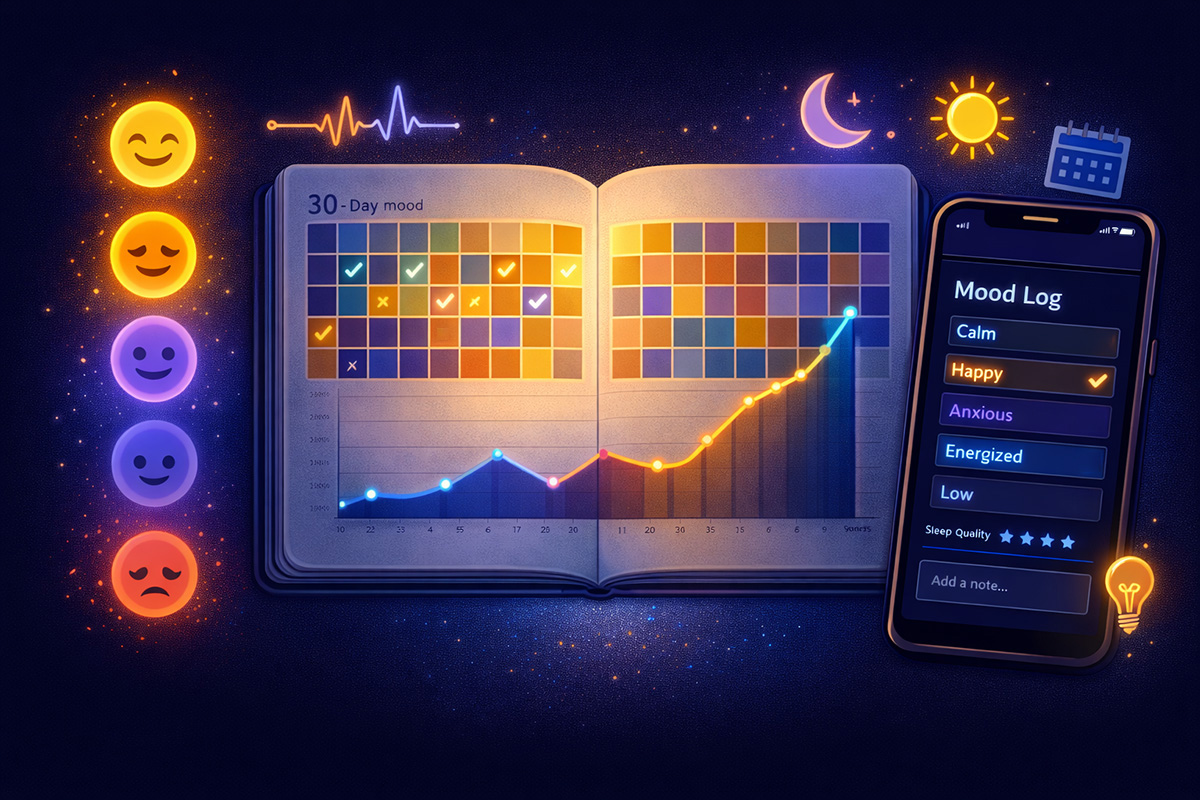
Most people have an approximate sense of how they're feeling on any given day. Good. Bad. Tired. Stressed. Okay. But ask them to describe the texture of their emotional life over the past month - which days were hardest and why, what triggered their worst afternoons, whether their mood follows a weekly pattern - and the picture goes blank.
This is the problem that mood tracking solves. Not by giving you more to think about, but by giving you something to look at.
The research on what happens when people consistently log their emotions is both surprising and actionable. A 2023 study from Arizona State University found that simply tracking positive emotions makes them persist into the next day. A 30-day community study from Monash University found measurable reductions in both depression and anxiety scores. Research from UCLA found that naming an emotion produces immediate changes in brain activity that parallel the effects of therapy.
The global mental health apps market was valued at USD 7.38 billion in 2024, with 41% of surveyed adults reporting use of a mental health app in the past 12 months (BMC Public Health, 2024). The majority of those apps center on mood tracking. Something is driving the adoption - and the research suggests it's working.
What Actually Happens When You Start Tracking Your Mood
Logging your mood is not just a record-keeping activity. The act of observation itself changes what you're observing - a phenomenon researchers now call the "observer effect" in behavioral contexts, and one that is being deliberately harnessed in clinical psychology.
Before understanding how, it's worth noting what you're doing when you track your mood: you are stepping outside your immediate emotional experience and taking a measurement of it. You are simultaneously the subject and the scientist. That shift in perspective - from being inside your feelings to briefly observing them - is one of the central mechanisms by which mindfulness, CBT, and therapy all operate. Mood tracking makes it a daily habit.
Pennebaker's 40 Years of Research
James Pennebaker at the University of Texas at Austin published the first expressive writing study in 1986, and the paradigm he created has since been tested in over 400 studies across four decades. His basic protocol - writing about emotional experiences for 15–20 minutes over 3–5 sessions - consistently produced:
- Significant drops in physician visits in the following months
- Improvements in academic performance for students who wrote about emotional topics
- Faster re-employment for laid-off executives who wrote about the experience of being let go
- Improved immune system markers including T-lymphocyte response
A comprehensive meta-analysis of expressive writing research found a consistent positive effect across physical, psychological, and functional outcomes. The mechanism Pennebaker proposed: translating diffuse emotional states into language forces a cognitive organization that reduces the mental burden of processing unresolved experiences. You convert an emotional tangle into something that has a beginning, middle, and end.
Affect Labeling: The Neuroscience of Naming What You Feel
In 2007, Matthew D. Lieberman and colleagues at UCLA published one of the most cited findings in modern affective neuroscience. The study, "Putting Feelings Into Words," used fMRI to measure brain activity while participants labeled their emotional states.
The result: simply naming an emotional state - a process Lieberman called "affect labeling" - reduced amygdala activity in response to negative emotional stimuli. It simultaneously triggered increased activity in the right ventrolateral prefrontal cortex (RVLPFC). These two regions were inversely correlated through the medial prefrontal cortex, meaning the act of naming an emotion activated higher-order thinking and quieted the brain's alarm system.
In a striking applied demonstration within the same paper, arachnophobic patients who verbalized their feelings about spiders while approaching them were physically able to move closer to spiders than those using reappraisal, distraction, or standard exposure techniques.
The UCLA Health summary stated: "Putting feelings into words produces therapeutic effects in the brain."
What this means for mood tracking: every time you open your journal and log "I felt anxious this afternoon and I'm not sure why," you are performing an act of affect labeling. You are reducing amygdala reactivity. You are engaging your prefrontal cortex. You are, in a neurologically meaningful sense, regulating your own emotional state through the act of naming it. This is not a metaphor.
Emotional Granularity: Why Precision Changes Everything
Most people operate with a small emotional vocabulary. Good. Bad. Stressed. Fine. Happy. Sad. The problem with this coarseness is that "bad" covers an enormous range of distinct experiences - anxiety about the future, guilt about the past, frustration with circumstances, grief, loneliness, exhaustion - each of which calls for a different response.
Lisa Feldman Barrett (Northeastern University) and Todd Kashdan (George Mason University) formalized this under the concept of emotional granularity: the ability to construct precise, context-specific emotional experiences - distinguishing "angry" from "fearful," "exhausted," or "lonely," rather than simply feeling generically "bad."
Their research, published in Current Directions in Psychological Science (2015), found that people with high emotional granularity show measurably better outcomes across almost every dimension studied:
- Less likely to use maladaptive coping strategies like binge drinking or aggression
- Lower neural reactivity to social rejection
- Less severe anxiety and depressive disorders
- Fewer doctor visits, fewer medications, fewer hospitalizations for illness
- Better social and emotional functioning overall
The critical finding for mood tracking: a 2021 study published in Frontiers in Psychology confirmed that emotional granularity itself increases with intensive ambulatory assessment. Meaning: the act of repeatedly logging your emotions over time actually trains the brain to become more emotionally precise. You don't arrive at mood tracking already knowing how to distinguish your emotions. You learn to distinguish them by tracking.
This matters especially for people who struggle to identify their feelings - a condition called alexithymia, affecting approximately 10% of the general population. Research on alexithymia treatment shows that structured daily logging provides a scaffold for emotional vocabulary development, gradually building the awareness that therapy targets in a clinical setting.
The Observer Effect: Does Tracking Change Your Mood?
The most counterintuitive finding in recent mood tracking research comes from Arizona State University. Researcher Reihane Boghrati and co-authors ran two studies involving 413 participants over 21 and 28 days respectively, published in the Journal of Experimental Social Psychology (2023).
The core finding: emotion tracking - not just reporting - increases the persistence of positive, but not negative, emotions.
Being reminded of past positive emotional states boosted how positive people felt the next day. The mechanism: humans naturally have a negativity bias - we remember unpleasant experiences far more vividly than pleasant ones (an evolutionary adaptation that prioritized threat memory). Mood tracking creates a "positive archive" that counteracts this bias. When the app reminds you of yesterday's good moment, you re-experience some of its positive affect - something that would never happen spontaneously because the negativity bias would have crowded it out.
Importantly, the effect was asymmetric: negative emotions did not persist more in the tracking condition. Tracking doesn't amplify bad days - it amplifies good ones.
Boghrati's explanation: "If I feel positive today, and if I'm reminded tomorrow that I felt positive yesterday, then I will feel more positive."
The practical implication: even setting aside the self-awareness and pattern-detection benefits of mood tracking, the simple act of logging is making your positive emotions more durable than they would otherwise be.
Paper vs. Digital: The Compliance Gap
Research comparing paper and digital mood diaries produced one of the most striking findings in the digital health literature. Patient-reported compliance with paper diaries: 90%. Actual paper compliance verified electronically: 11%. Electronic diary compliance: 94%.
Paper mood tracking is almost entirely back-filled - people fill in what they think they felt, not what they actually felt at the time. Digital tracking with timestamped entries eliminates this reconstruction bias and produces data that reflects your actual emotional experience rather than your remembered approximation of it.
The Patterns You'll Discover (Science Explains Why)
One of the most powerful returns from 30 days of mood tracking is the emergence of patterns that are invisible in the moment but unmistakable in aggregate. The science explains exactly what to expect.
Time-of-Day Patterns
In 2011, Scott Golder and Michael Macy (Cornell University) published a landmark study in Science - analyzing 509 million Twitter posts from 2.4 million users across 84 countries over two years, using linguistic analysis to measure emotional content. Their findings:
- People wake in a generally positive mood that deteriorates as the day progresses
- Positive affect peaks relatively early in the morning, then again near midnight
- There is a consistent midday mood dip
- This pattern held across 84 diverse countries - suggesting it's driven by circadian biology, not culture
For most people, the late morning to mid-afternoon period is the most emotionally vulnerable time of the workday. Mood tracking will make this visible in your own data within two weeks.
Day-of-Week Patterns
The Cornell study also found that people are universally in a better mood on weekends than weekdays, with the Saturday morning peak in positive affect delayed by two hours - consistent with sleeping in. Work and commuting are the primary mood suppressors during the week.
Knowing your own day-of-week patterns allows you to schedule high-stakes interactions, creative work, and social commitments on your peak days - and protect your lowest days with lower cognitive demands and more recovery time.
Trigger Patterns
A 15-day diary study of 30 adults found that connecting mood logs to daily activities - exercise, sleep quality, social interaction, nutrition - reveals the specific correlations that drive emotional states. Within a month, most trackers can identify their personal mood triggers with a specificity that would take years of unassisted self-observation.
This is the transition from tracking to insight: you stop reacting to your moods and start understanding them.
The Sleep-Mood Loop: Why Tracking Both Together Matters
Stanford Medicine research published in 2025 confirmed what behavioral scientists have long suspected: sleep and mood have a bidirectional relationship. Poor sleep degrades next-day mood and emotion regulation capacity. Poor mood disrupts sleep quality and architecture. Each feeds the other.
A meta-analysis published in PMC (2021, "The effect of sleep deprivation and restriction on mood, emotion, and emotion regulation") quantified the effects:
- Moderate, positive effect of sleep loss on negative mood (more negative affect)
- Large, negative effect of sleep loss on positive mood (positive affect drops significantly)
- Small negative effect on adaptive emotion regulation capacity
A 14-day diary study found that self-reported sleep quality was the single best predictor of next-day mood from a range of sleep variables - including number of awakenings and sleep timing. Sleep quality was directly associated with the ability to use positive emotion regulation strategies the following day.
Separately, people with insomnia are 10 times more likely to have clinical depression and 17 times more likely to have clinical anxiety than the general population.
The practical implication: tracking mood in isolation gives you half the picture. Tracking mood alongside sleep quality gives you the full pattern - including the days where a rough night is quietly driving an afternoon of irritability and low tolerance that you might otherwise attribute to work stress or personality.
Research using wearable data published in Nature npj Digital Medicine (2024) demonstrated that combined sleep and circadian rhythm monitoring could predict next-day mood episodes with an accuracy (AUC) of 0.80 for depressive episodes and 0.98 for manic episodes. The same principle applies in everyday life: the combination of sleep and mood data is a more powerful predictive tool than either alone.
What 30 Days of Tracking Actually Changes
The Monash University study is the most direct research on the 30-day threshold. Researchers found that using a mood tracking app for 30 days produced:
- Increased mental wellbeing scores
- Reduced depression scores
- Reduced anxiety scores
- For those already symptomatic at baseline: improvements were mediated by increases in emotional awareness developed during the period
The Arizona State studies (21 and 28 days, 413 participants) documented the "positive persistence effect" - within three to four weeks, positive emotions began to linger into the next day for participants who tracked versus those who only reported. The negativity bias started to shift.
Based on the research, here is a realistic week-by-week expectation of what the 30-day experience looks like:
Week 1: Building the Vocabulary
The first week is mostly about establishing the habit and developing a richer emotional vocabulary. You may find yourself reaching for words beyond "good," "bad," or "stressed" - and that search itself is emotionally granularity development in action. Emotional granularity begins to increase.
Week 2: Pattern Recognition
Time-of-day and day-of-week trends become visible. You may notice that your mood consistently dips on Wednesday afternoons, or that Sunday evenings carry a predictable anxiety. Seeing a pattern is the first step toward changing it.
Week 3: The Observer Effect Begins
The positive persistence effect starts to emerge. You begin reviewing recent entries and noticing that good moments you'd forgotten about still carry some emotional residue when re-encountered. The recall bias starts to shift.
Week 4 and Beyond
By day 30, you have a month of emotional data that no amount of introspective effort could have produced without the tracking. Clinically measurable reductions in anxiety and depression scores (from the Monash study). Increased emotional self-awareness. Improved capacity for emotion regulation. The ability to connect your mood to specific triggers - sleep, exercise, social interaction, work - with a specificity that makes behavior change genuinely possible.
How to Start - and What to Track
Starting a mood tracking practice is simple. Maintaining it is a habit-formation problem, and habit formation research is clear: the simpler the starting action, the higher the follow-through rate.
The Minimum Viable Log
Commit to three data points per day, ideally at the same time each day (triggering the habit loop through timing consistency):
- A mood rating - even a simple scale (1–5 or emoji-based) is enough to track patterns
- One specific emotion label - not just "good" or "bad," but the most precise word you can find. Anxious. Grateful. Frustrated. Excited. Depleted. Calm.
- One contributing factor - what one thing most contributed to how you felt today? Sleep, exercise, a conversation, a deadline, a meal?
Three data points take less than 90 seconds. That is your minimum viable mood log. Research on Daylio, a mood tracking app studied in PMC, found it effective and reliable with high compliance - because the friction is low enough that the habit actually forms.
The Two-Check Approach
Midday and evening check-ins produce richer data than a single nightly log, because the EMA (Ecological Momentary Assessment) research consistently shows that contemporaneous logs are more accurate than end-of-day reconstruction. If two check-ins is too much to start, begin with one - at the same time each evening, immediately after dinner.
Connect Sleep to Mood
From day one, note your sleep quality alongside your mood. Even a simple 1–5 sleep quality rating is enough to reveal the sleep-mood correlation in your own data within two weeks.
Review Weekly
Once a week - ideally as part of a broader weekly review - look at your mood log for patterns. This is where the data becomes insight. Without a periodic review, you have a journal. With the review, you have a feedback system.
SparkDay's journal is built for exactly this: daily mood entries with notes, a habit tracker for maintaining the check-in habit, and reminders to trigger your daily log at a consistent time. The data doesn't interpret itself - but after 30 days, it gives you something genuinely useful to interpret.
You already know approximately how you feel each day. After 30 days of tracking, you'll know why.
Ready to Take Control of Your Day?
SparkDay combines daily planning, step tracking, habit building, and focus timers in one free app.