Time Management for Students: 8 Evidence-Based Strategies That Actually Work
80-95% of college students procrastinate. These 8 strategies - spaced repetition, time blocking, active recall, sleep science - are backed by published research and proven to improve GPA.
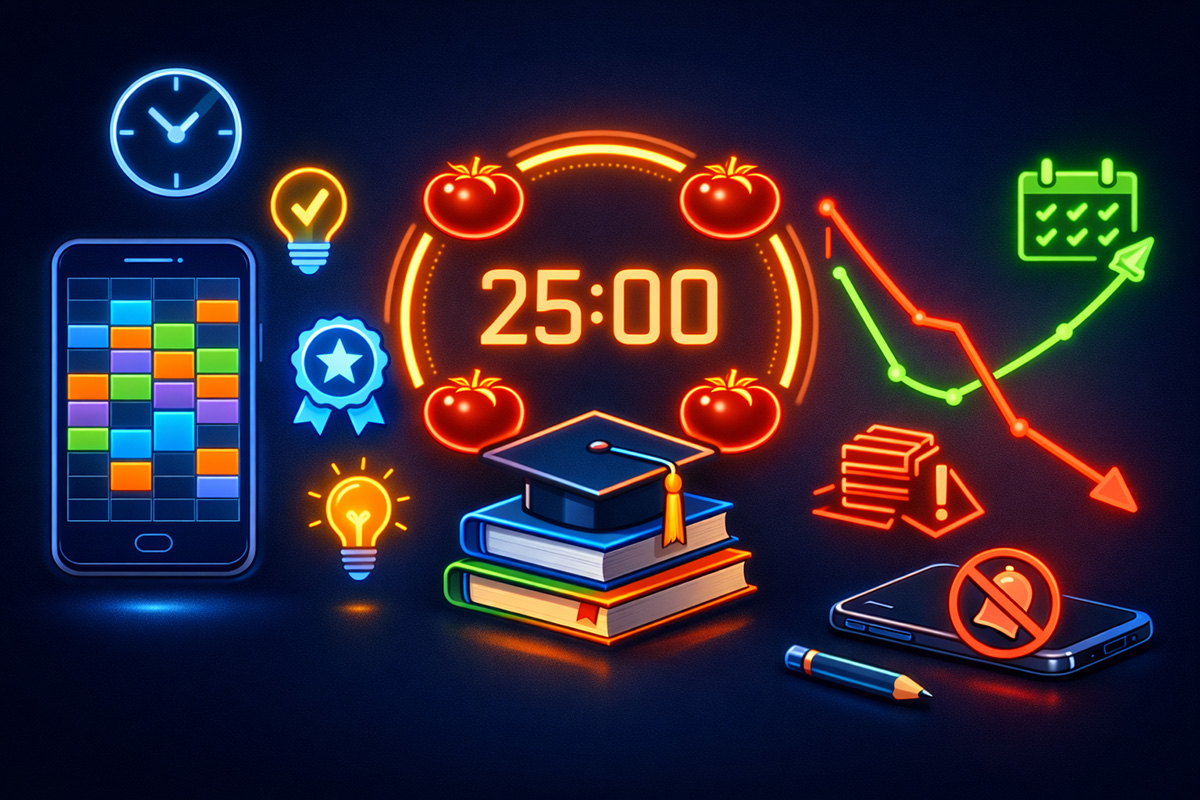
Here is an uncomfortable set of statistics about how college students actually spend their time.
The U.S. Department of Education guideline is 2–3 hours of outside study per credit hour per week - approximately 30 hours per week for a full course load of five classes. The 2024 National Survey of Student Engagement found that first-year students average 14.3 hours per week preparing for class. Less than half the recommended amount.
Meanwhile, 74% of college students use their smartphones for more than five hours daily. Fewer than 1 in 25 students can study for a full hour without checking their phone. The average time to regain deep focus after a phone interruption: 23 minutes and 15 seconds (UC Irvine researcher Gloria Mark).
And 78% of students report struggling with time management throughout their college experience, according to Cengage's Student Engagement Insights survey.
The good news: the research on what actually improves student time management, academic performance, and retention is clear, well-replicated, and surprisingly actionable. These eight strategies are not generic advice - each one has a published evidence base. Together, they represent the most leverage-efficient changes a student can make.
The Student Time Crisis: What the Data Actually Shows
Before the strategies, it's worth understanding the scale of the problem - because most students significantly underestimate both their time management challenges and the academic cost of those challenges.
Procrastination Is Nearly Universal
Research across multiple institutions and countries consistently finds that 80–95% of college students procrastinate to some degree, with 75% identifying themselves as procrastinators. Task-specific data from introductory psychology courses shows:
- 46% of students always or nearly always procrastinate on writing term papers
- 30% procrastinate on weekly reading assignments
- 28% procrastinate on exam preparation
Two-thirds of students who procrastinate report moderate-to-high psychological distress as a result. And researcher William Knaus estimates that 25% of chronic procrastinators are likely to drop out of college - making procrastination not just an academic inconvenience but an enrollment risk factor.
The Planning Fallacy
Daniel Kahneman and Amos Tversky coined the "planning fallacy" in 1979: the systematic tendency to underestimate how long tasks will take, despite knowing that similar tasks took longer in the past. The classic student study, conducted by Buehler, Griffin, and Ross (1994, published in the Journal of Personality and Social Psychology), found that psychology students estimated their senior thesis would take 33.9 days on average. The actual average completion time: 55.5 days - a 64% underestimate. Only 30% finished in their predicted time.
Students who were explicitly warned about the planning fallacy still underestimated. Awareness alone doesn't fix it - only systematic planning strategies do.
The Academic Cost of Poor Time Management
The research here is consistent. A landmark 1991 study by Britton and Tesser found that time management behaviors explained 21% of the variance in cumulative college GPA - outperforming standardized test scores as a predictor of academic performance. A 2023 study at Carnegie Mellon University, tracking first-year college students across a full semester and published in PNAS, found that every additional hour of average nightly sleep corresponded to a +0.07 increase in end-of-term GPA. Students sleeping nine or more hours averaged GPAs of 3.24 versus 2.74 for students sleeping six hours or less.
The opportunities are real. The question is which interventions actually move the needle.
Strategy 1: Spaced Repetition (Stop Cramming Forever)
Spaced repetition is one of the most well-replicated findings in cognitive psychology - with over 200 studies across more than a century confirming its superiority over massed practice. Yet most students still cram before exams.
Hermann Ebbinghaus established the foundational principle in the 1880s: the brain forgets information on a predictable exponential curve - rapidly at first, then more slowly. Each review at the right interval resets the curve and extends the next optimal review interval. The sequence: review within one hour of learning → within 24 hours → within one week → within one month.
The evidence against cramming is damning. While massed practice may produce marginally better immediate recall (which is why the night before a morning exam, cramming feels productive), spaced repetition dramatically outperforms cramming on delayed tests - four weeks later and beyond. Case study data shows that after 72 weeks, spaced learners retained far more than crammed learners across equivalent total study time.
A 2025 study in ScienceDirect involving pharmacy students found that practice testing combined with spaced repetition significantly improved academic performance compared to traditional review methods.
How to Apply It
Divide study sessions by subject across multiple days rather than stacking all review for one subject into one marathon session. For a test on Friday:
- Monday: First review of material (30 minutes)
- Wednesday: Second review - active recall from memory (20 minutes)
- Thursday evening: Brief final review of weak spots only (15 minutes)
This distributes the same 65 minutes of study across three sessions, dramatically improving long-term retention compared to a single 65-minute session the night before. Schedule each session in your planner at the start of the week so it actually happens.
Strategy 2: Time Blocking Your Week
The research on time blocking for students shows an average GPA improvement of 0.5 points compared to control groups using traditional to-do lists, according to a study published in the Journal of College Student Development. Students using time blocking also report lower stress and higher academic confidence.
The mechanism: time blocking eliminates decision fatigue (you've already decided when and what to study), reduces the ambiguity that is procrastination's natural habitat, and makes your spaced repetition schedule visible and actionable.
How to Build Your Semester Block
- Start with fixed commitments - class times, lab sessions, work shifts, recurring meetings. These are non-negotiable anchors.
- Apply the 1-for-1 rule - block at least one hour of outside study for every hour of class time. For a 15-credit-hour semester, that's 15 hours of study blocks minimum per week.
- Schedule by subject, not by "studying" - "Study: 2 PM" is a to-do list. "Organic Chemistry - problem set + flashcard review: 2–3:30 PM" is a time block. Specificity is what the research supports.
- Build in planning fallacy buffers - add 30–50% more time than you estimate for major assignments. If you think the essay will take two hours, block three.
- Protect your peak hours - more on this in Strategy 7.
Cal Newport (Georgetown professor, author of Deep Work) advocates time-block planning as central to both academic and professional success, arguing that without it, you are permanently in reactive mode - doing whatever feels most urgent, rather than what matters most.
Strategy 3: The Pomodoro Technique for Study Sessions
Developed by Francesco Cirillo in the 1980s and now one of the most widely used focus techniques in academic settings, the Pomodoro Technique operates on a simple principle: 25 minutes of focused work, followed by a 5-minute break, repeated in cycles.
The research evidence is increasingly supportive. A 2025 study published in PMC (investigating the effectiveness of self-regulated, Pomodoro, and Flowtime techniques) found that structured Pomodoro intervals consistently improved focus, reduced mental fatigue, and enhanced sustained task performance compared to self-paced break schedules. Separately, a 2025 scoping review in PMC found the Pomodoro technique enhanced anatomy lesson retention by improving focus and reducing cognitive overload.
The neuroscience foundation: the brain's optimal sustained attention window is approximately 20–45 minutes before cognitive fatigue sets in. The 25-minute Pomodoro interval aligns with this natural attention rhythm. And the technique harnesses the Zeigarnik Effect - the brain's tendency to fixate on incomplete tasks - by making each session small enough to start without resistance.
Adapting Pomodoro for Study
- Use the first 2 minutes to write your specific goal for the session ("I will complete practice problems 1–10")
- Phone face-down and on Do Not Disturb for the full 25 minutes
- After 4 Pomodoros, take a 20–30 minute break - this is the natural session length for sustained cognitive work
- Adjust interval length as needed: some research suggests 45-minute sessions with 10-minute breaks work better for complex analytical tasks
Strategy 4: Sleep Is Academic Strategy, Not a Luxury
The Carnegie Mellon/PNAS 2023 study is the most rigorous research available on sleep and student GPA. Tracking first-year college students throughout an entire semester:
- Students sleeping nine or more hours averaged GPAs of 3.24
- Students sleeping six hours or less averaged GPAs of 2.74 - a 0.5 GPA difference
- Every additional hour of average nightly sleep correlated with a +0.07 GPA improvement
- Below six hours of sleep, GPA drops sharply - researchers called this "accumulating massive sleep debt that impairs health and study habits, compromising the whole system"
The mechanism is not just about alertness. Sleep is the period during which the brain consolidates declarative memories (facts, concepts, names) and procedural memories (problem-solving patterns, skills). Slow-wave sleep - which occupies the early part of the night - is critical for declarative memory consolidation. REM sleep - which dominates the second half of a full night - supports procedural learning and creative synthesis. Cutting sleep short sacrifices REM disproportionately.
The popular student belief that staying up until 3 AM studying is productive is directly contradicted by the evidence. Hours of sleep deprivation followed by morning exams is one of the least effective academic strategies available.
Sleep consistency matters as much as duration. High academic performers in research show earlier and more consistent bed and wake times than lower performers - even with similar total sleep duration.
Strategy 5: The 23-Minute Phone Problem
UC Irvine researcher Gloria Mark established one of the most important findings in modern attention research: it takes an average of 23 minutes and 15 seconds to fully regain deep focus after a single interruption. A task-switching cost of 23 minutes, from one phone check.
A 2025 meta-analysis of 45 studies, published in ScienceDirect, found a statistically significant negative effect of smartphone usage frequency on academic performance. The highest-impact behavior: smartphone multitasking during class had the largest negative effect of all smartphone-related behaviors on academic outcomes. APA research suggests task-switching can consume up to 40% of productive time.
The statistics about student phone use are worth confronting directly:
- College students average 6 hours 12 minutes of daily smartphone use
- Students check their phones 80–100 times per day
- Approximately 40% check their phone every 5–10 minutes while studying
- Research from The Boar (2025) found students risk spending the equivalent of 25 years of their life scrolling at current usage rates
Practical Solutions
Physical separation - leaving your phone in another room during study blocks - is more effective than willpower-based restrictions. Research shows that even the visible presence of a phone (face-down, silenced) impairs cognitive performance on demanding tasks, simply by drawing some share of attention.
Structured phone time - scheduling specific 10-minute phone-check windows between study blocks - is more sustainable than total prohibition and produces better results than unstructured access. Schedule it on your planner like any other activity.
App timers and grayscale mode reduce both the psychological pull of apps and the blue-light impact on evening alertness.
Strategy 6: Active Recall - The Most Effective Study Method
The "testing effect" is one of the most replicated findings in cognitive psychology. Roediger and Karpicke (2006, Psychological Science) demonstrated that students who took memory tests after studying retained dramatically more material on a one-week delayed test than students who restudied the same material:
- At a 5-minute delay: repeated studying was slightly better
- At a 1-week delay: the testing condition dramatically outperformed re-reading
Active recall - generating an answer from memory, rather than recognizing it from a page - requires the brain to reconstruct the memory trace, which strengthens it. Re-reading creates the "fluency illusion": material feels familiar, so the brain signals confidence, but familiarity is not retrieval. When the exam arrives, retrieval is what's required.
How to Apply Active Recall
- Cornell note method: Divide your notes into a main area and a narrow cue column. After class, write questions in the cue column. Cover the main notes and answer the questions from memory.
- Flashcards: Physical or digital - the act of testing yourself is what matters, not the medium. Combine with spaced repetition by reviewing cards you got wrong more frequently.
- The Feynman Technique: After studying a concept, explain it in simple language as if teaching it to someone who knows nothing about the subject. Gaps in your explanation reveal gaps in your understanding.
- Practice tests: Past exam papers are one of the most effective study tools available - they're both active recall and spaced practice simultaneously.
Strategy 7: Study at Your Biological Peak
The most effective study time is not a universal answer - it depends on your chronotype. Research published in Frontiers in Human Neuroscience (2017) demonstrated that people consistently perform significantly better on complex cognitive tasks at their own optimal time of day. The effect is larger for tasks requiring reflective thinking and smaller for simpler tasks.
The practical reality for most college-age students: puberty triggers a biological shift in sleep/wake timing approximately 2–3 hours later in the day, peaking at age 19. Most college students are naturally evening-leaning. Forcing demanding cognitive work at 8 AM creates a circadian mismatch - performing cognitively demanding work at your biological low point.
This doesn't mean ignoring your morning classes. But it does mean scheduling your most cognitively demanding self-study - problem sets, essay writing, exam review - at your personal chronotype peak, not at an arbitrary "studying in the morning is virtuous" time.
Find Your Peak
For one week, note your energy and focus levels every two hours (SparkDay's mood or energy check-in is useful here). After seven days, the pattern of your peak cognitive hours will be clear. Schedule your hardest study blocks to match.
Strategy 8: Build Study Habits, Not Study Willpower
Willpower is a finite resource that depletes throughout the day. Roy Baumeister's ego depletion research established that acts of self-control draw from a limited pool. Relying on willpower to maintain a study schedule is structurally unsound - it will fail whenever willpower is low, which is most of the time.
Habits, by contrast, require very little willpower once established - because they run automatically in response to environmental cues. Phillippa Lally's 2010 UCL study found that habit automaticity plateaued at a median of 66 days (ranging from 18 to 254 days for different behaviors). The popular "21-day" figure is not supported by the research.
A 2024 Springer Nature study on habits in university students' self-regulated learning found that habits are central to academic self-regulation - and that the barrier most students face is not motivation but establishing the initial routine that can eventually run without motivation.
Building Academic Habits
BJ Fogg's Tiny Habits model offers the most research-backed approach: start with a version of the behavior so small that motivation is irrelevant. "I will open my flashcards and review 3 cards" is a tiny habit that can grow naturally. "I will study for 3 hours" is an aspiration that fails most days.
Habit stacking - attaching study habits to existing anchors - dramatically increases follow-through: "After I eat dinner, I will open my notes for 20 minutes" uses an existing automatic behavior as a trigger.
Tracking habit completion produces a visual streak - what James Clear calls the "don't break the chain" effect - that creates its own motivational momentum. Research on implementation intentions (Gollwitzer) shows that specifying when and where you'll study increases follow-through by approximately 3x compared to vague study intentions.
Putting It Together: A Week in the Life of an Evidence-Based Student
Here's what a week looks like when these eight strategies are integrated:
Sunday: The Weekly Review (30 minutes)
Review the coming week's commitments and deadlines. Time-block specific study sessions for each subject, applying the spaced repetition schedule. Identify which sessions are highest priority. Set reminders for each block.
Daily: The Study Session Structure
- Pre-session (2 minutes): Write a specific goal for this session ("Complete practice problems 1–15 for Calculus")
- Phone away and timer on - Pomodoro intervals (25 on, 5 off) or 45-minute blocks based on your preference
- Active recall throughout: After reading each section, close the notes and recall the key points. Quiz yourself.
- Post-session (2 minutes): Note what you completed and what needs to be covered in the next session
Evening: The Wind-Down Protocol
Stop studying at least 60 minutes before bed. Screens down 60 minutes before sleep target. Write tomorrow's three priority tasks. Protect your sleep - it is the most academically productive thing you will do between 11 PM and 7 AM.
The Numbers
Students who implement time blocking improve GPA by an average of 0.5 points. Students sleeping adequate hours see similar gains. Active recall versus re-reading dramatically extends retention. Spaced repetition reduces total study time while improving outcomes. The planning fallacy buffer prevents the last-minute cramming that produces temporary recall but poor long-term retention.
None of these strategies require exceptional intelligence or discipline. They require a structured system - a weekly plan, consistent time blocks, clear habits, and a tracking mechanism to see what's actually working. The evidence base for these eight strategies spans over a century of cognitive psychology and education research. The only remaining variable is whether you actually use them.
SparkDay's 24-hour planner, focus timer, habit tracker, and reminders were built to make exactly this kind of structured student routine effortless to implement and maintain - because the best planner app is the one you'll actually use.
Ready to Take Control of Your Day?
SparkDay combines daily planning, step tracking, habit building, and focus timers in one free app.