Why You Procrastinate (And How a Daily Planner + Focus Timer Actually Fixes It)
Procrastination isn't laziness - it's emotion regulation. Learn the neuroscience of why you avoid tasks, discover your procrastinator type, and apply 6 research-backed tools that actually break the cycle.
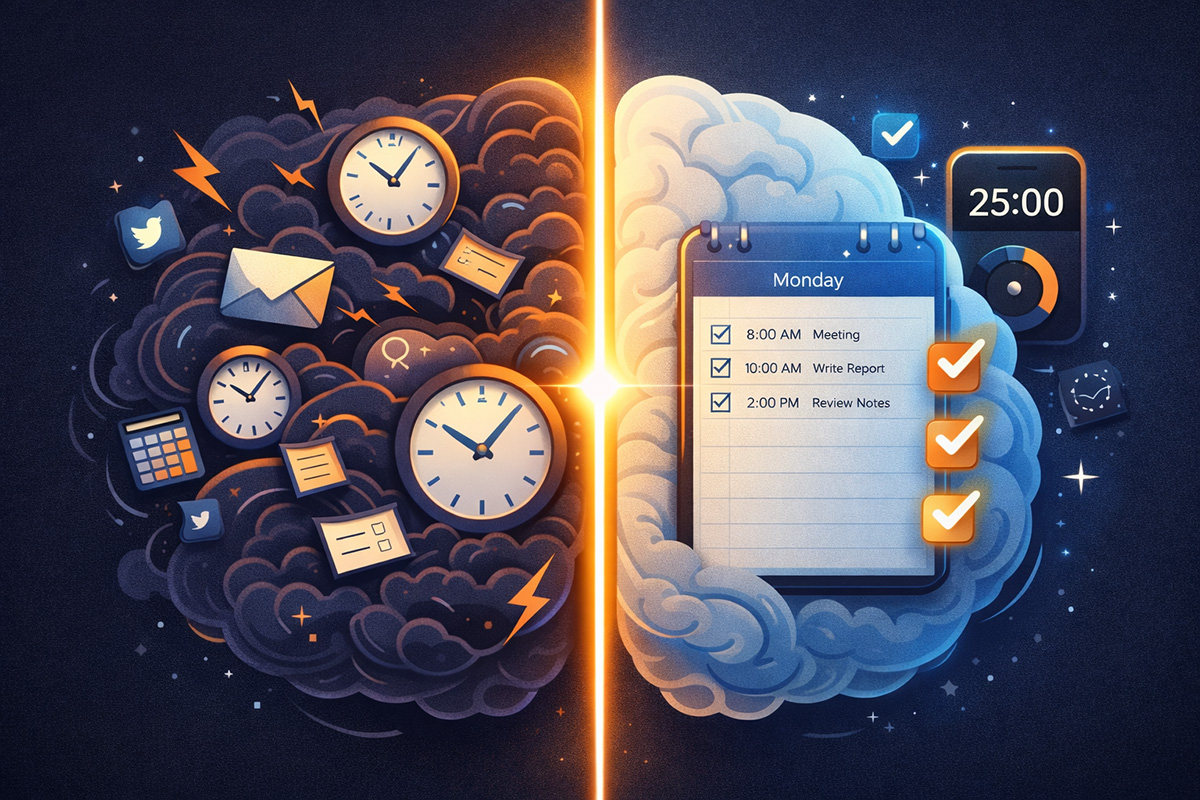
Procrastination isn't a time management problem. It's an emotion regulation problem. That single reframe - backed by a growing body of neuroscience and psychology research - changes everything about how you fix it.
If you've ever told yourself you just need more discipline, a better to-do list, or a stricter schedule, you've been solving the wrong problem. The real culprit is your brain's emotional response to certain tasks - and once you understand that, the path forward becomes much clearer.
This article covers the genuine science of procrastination, the six types of procrastinator (most people are a mix), and the practical systems that actually break the cycle - including time blocking, focus timers, and implementation intentions.
The Real Neuroscience of Procrastination
For decades, procrastination was treated as a character flaw - laziness dressed up in excuses. But neuroimaging research has fundamentally changed that picture.
The Amygdala vs. the Prefrontal Cortex
At the neurological level, procrastination is a fight between two brain systems. The prefrontal cortex - the seat of planning, rational decision-making, and long-term thinking - knows you need to start that report, send that email, or book that appointment. But the amygdala, the brain's threat-detection and emotional processing center, registers the task as aversive: threatening, boring, anxiety-inducing, or overwhelming.
When the amygdala fires strongly enough, it overrides the prefrontal cortex. The result is avoidance - not because you're lazy, but because your brain is doing exactly what it's designed to do: protect you from discomfort.
The Larger Amygdala Finding
A landmark fMRI study published in Scientific Reports found a striking structural difference: chronic procrastinators tend to have a larger amygdala than non-procrastinators. More significant still, procrastinators showed weaker connectivity between the amygdala and the dorsal anterior cingulate cortex - the brain region responsible for translating intention into action. In other words, their emotional brake is stronger and their gas pedal is weaker, neurologically speaking.
This is not a life sentence. Neuroplasticity means these patterns can change. But it does confirm that telling a procrastinator to "just do it" is about as useful as telling someone with a broken leg to run faster.
Procrastination as Emotion Regulation
Drs. Timothy Pychyl and Fuschia Sirois at Carleton University have spent over two decades studying procrastination and arrived at a conclusion that is simultaneously obvious and transformative: procrastination is a strategy for managing negative emotions in the short term, at the cost of your future self.
In their 2013 paper published in Social and Personality Psychology Compass, Sirois and Pychyl argued that procrastination functions as a form of short-term mood repair. When a task triggers anxiety, self-doubt, boredom, or frustration, avoidance provides immediate relief. The problem is that the future version of you inherits both the original task and a new layer of guilt and stress.
The 6 Types of Procrastinator
Procrastination isn't one thing. Research and clinical psychology have identified at least six distinct patterns, each driven by a different emotional trigger. Most people recognize themselves in two or three of these.
1. The Perfectionist
Paralyzed by impossibly high standards. The Perfectionist doesn't avoid work - they avoid finishing it. Starting is fine; completing and releasing is terrifying because finished work can be judged. The emotional driver is fear of criticism, which disguises itself as thoroughness.
2. The Avoider
Steers away from tasks that trigger fear of failure - or surprisingly, fear of success. Avoiders are often hyperaware of how others perceive them, and they'd rather be seen as someone who didn't try than someone who tried and failed. Not trying feels safer than visible effort.
3. The Thrill-Seeker (Crisis Maker)
Genuinely believes they work best under pressure - and they're partly right. Deadline adrenaline is real. The brain releases dopamine and norepinephrine under time pressure, which can sharpen focus. The problem: the strategy is unsustainable and burns others around you. The emotional driver is the need for stimulation.
4. The Overwhelmed Procrastinator
Faces a task so large or complex that they freeze. Not avoidance of the task's emotional content, but avoidance of its sheer scope. This person often has full intention to start - but the mountain looks unclimbable, so they don't lace their boots.
5. The Dreamer
Loves the planning stage but resists execution. Dreamers can spend hours organizing, color-coding, and strategizing - activities that feel productive but don't move the needle. Planning gives a sense of progress without the vulnerability of actual action.
6. The People Pleaser
Says yes to everything, then procrastinates on all of it because none of it was their actual priority. The backlog grows not from laziness but from the inability to say no or set boundaries around their time and attention.
Why Willpower and To-Do Lists Fail
The Willpower Myth
Willpower - the capacity to override impulse through sheer force of intention - is a finite resource. Baumeister's ego depletion research showed that acts of self-control draw from a limited pool that depletes throughout the day. By 3 PM, your willpower reserves are genuinely lower than they were at 8 AM. Relying on willpower to beat procrastination is like trying to drive across the country on a quarter tank - you might make some progress, but the strategy fails at scale.
More critically, willpower attacks the symptom (not starting) rather than the cause (emotional avoidance). The moment a task triggers anxiety or boredom, willpower is overwhelmed by a system that evolved over millions of years specifically to steer you away from discomfort.
Why To-Do Lists Backfire
The research here is humbling. Studies suggest that only about 15% of tasks that end up completed actually started as explicit to-do list items. The structural problem with to-do lists is that they have an extremely low barrier to entry (adding a task takes three seconds) and an extremely high barrier to execution - they do nothing to reduce the emotional resistance that caused procrastination in the first place.
For a procrastinator, a long to-do list doesn't inspire action. It inspires dread. Every item on that list is a reminder of what hasn't been done. The list scrolls down, the overwhelm compounds, and the amygdala wins again.
To-do lists also lack temporal anchoring. "Email the accountant" can mean today, this week, or vaguely sometime. Without a specific time slot, the task floats in ambiguity - and ambiguity is procrastination's natural habitat.
Time Blocking: The Planning Method That Actually Works
If to-do lists fail procrastinators, what works? The answer, supported by productivity research and cognitive psychology, is time blocking - assigning specific tasks to specific time slots in your calendar rather than maintaining an undated task list.
Why Time Blocking Works Neurologically
A 2022 study in Scientific Reports found that clear, short-term deadlines reduce procrastination and maintain engagement by simplifying decision-making. When a task has a designated slot - "I will work on the quarterly report from 9 to 10 AM" - two things happen. First, the prefrontal cortex has a concrete target to work toward rather than an open-ended threat. Second, the decision of when to do something has already been made, which removes an entire category of mental friction.
Time blocking also combats what researchers call "present bias" - the tendency to value immediate comfort far more than future reward. By making tomorrow's work visible on today's calendar, you make the future self more real and the avoidance cost more visceral.
How to Time Block Effectively
- Schedule the hardest task first. Your prefrontal cortex is freshest in the morning. Block your highest-resistance task for 9 to 10 AM before reactive work colonizes your day.
- Give tasks more time than you think they need. Procrastinators underestimate task duration (the planning fallacy). Build in buffer. A task that takes 30 minutes should get a 45-minute block.
- Protect your blocks like meetings. A time block is a commitment to yourself. Treat it with the same respect you'd give a meeting with your manager.
- Leave transition time between blocks. Back-to-back scheduling creates the same overwhelm as a wall-to-wall to-do list. Five-minute breaks between blocks let the brain reset.
- Review and adjust weekly. Time blocking isn't a rigid prison - it's a living plan. Review what worked each week and adjust your blocking strategy accordingly.
SparkDay's daily planner was built around this principle. Rather than an undated task list, you schedule activities into a visual 24-hour timeline, so you can see exactly where your time goes - and where procrastination has been quietly stealing it.
The Focus Timer Trick That Eliminates Task Resistance
Even with a well-constructed time block, actually starting the task inside it can still feel like pushing a boulder uphill. This is where focus timers change the game.
The Zeigarnik Effect and Task Initiation
Psychologist Bluma Zeigarnik discovered that the brain fixates on incomplete tasks more than completed ones. The mental discomfort of unfinished work - often felt as background anxiety - is actually a neurological signal trying to get you to start. Focus timers harness this: once you start a task, the Zeigarnik Effect flips from aversion to momentum. The hard part isn't continuing; it's beginning.
Why "Just 25 Minutes" Works
The Pomodoro Technique - developed by Francesco Cirillo and studied extensively since - operates on a principle that neuroscience now validates: the brain's resistance is to the task as a whole, not to a bounded time interval. "Work on this project" triggers overwhelm. "Work on this project for 25 minutes, then stop" triggers a completely different - and far less threatening - cognitive appraisal.
Research published in PMC found the Pomodoro Technique associated with increased focus, reduced fatigue, and enhanced academic engagement. Studies suggest the brain can sustain optimal focus for 20 to 45 minutes before experiencing cognitive fatigue - the 25-minute Pomodoro interval aligns almost precisely with this natural attention window.
For ADHD brains and those with executive function challenges, the effect is even more pronounced. External timers reduce what researchers call "time blindness" - the difficulty in perceiving elapsed time - and make abstract work sessions concrete and survivable.
Using a Focus Timer in Practice
The key is treating the timer as a contract with yourself, not a productivity gimmick. When the timer starts, the task is the only task. No email tab, no phone - just you and the 25 minutes. When it ends, you stop, regardless of where you are. This builds trust with yourself and makes the next session easier to start.
SparkDay includes a built-in focus timer that visualizes completed sessions as blocks on your daily timeline - so you can literally see your focused work accumulating throughout the day. That visual record closes the loop the brain craves and makes the next session easier to start.
Implementation Intentions: The Research-Backed Commitment Device
Of all the tools in the anti-procrastination toolkit, implementation intentions may have the most robust evidence base - and the least name recognition.
What Are Implementation Intentions?
Developed and studied extensively by psychologist Peter Gollwitzer at New York University, implementation intentions are simple if-then plans: "If situation X arises, then I will do behavior Y."
A standard goal intention sounds like: "I'm going to work on my presentation." An implementation intention sounds like: "If it's 9 AM on Tuesday and I've made my coffee, then I will open the presentation file immediately and work for 30 minutes."
The Research Results Are Striking
A meta-analysis by Gollwitzer and Sheeran, drawing on 94 independent studies involving over 8,000 participants, found that implementation intentions had a medium-to-large effect on goal achievement (d = 0.65). This is an exceptionally strong effect size in behavioral psychology. Implementation intentions were particularly effective at promoting the initiation of goal-directed behavior - precisely the point where procrastination strikes hardest.
Gollwitzer's proposed mechanism is elegantly simple: by specifying the situational cue in advance, you create a mental link between that situation and the action. When the cue appears, the response fires automatically - without requiring a fresh act of willpower. The decision has already been made. You're not choosing to start; you're executing a pre-committed plan.
Writing Your Own Implementation Intentions
For each task you tend to procrastinate on, write an if-then plan that specifies:
- When: A specific time, day, or situational trigger ("after I eat lunch," "when I sit at my desk in the morning")
- Where: The specific location or context ("at my kitchen table," "with my headphones on")
- What, exactly: The first concrete action, not the whole task ("I will open the document and write three bullet points" - not "I will finish the report")
The more specific and concrete the if-then plan, the stronger the associative link and the lower the initiation resistance.
Building Anti-Procrastination Habits
Willpower is a tactic. Habits are a system. The most reliable way to beat procrastination long-term is to make non-avoidance the default - to build structures so that starting is easier than not starting.
1. Shrink the Starting Threshold
Your only goal when facing a procrastinated task is to begin - not finish, not do it well, just begin. This is sometimes called the "two-minute start": commit to working on the task for just two minutes. You're allowed to stop after two minutes. What almost always happens instead is that starting triggers momentum, the Zeigarnik Effect kicks in, and you continue naturally.
2. Reduce Friction in Your Environment
James Clear's concept of "friction reduction" from Atomic Habits applies directly to procrastination. If you want to write, keep your document already open when you sit down. If you want to exercise, sleep in your workout clothes. Every additional step between you and a task is an opportunity for avoidance. Design your environment so that starting is the path of least resistance.
3. Name the Emotion
Research by Dr. Sirois emphasizes self-compassion as a genuine anti-procrastination tool - not self-indulgence, but honest emotional acknowledgment. Before avoiding a task, pause and name what you're feeling: "I'm avoiding this because it makes me anxious about failure." Studies show that labeling emotions ("affect labeling") reduces amygdala activation and gives the prefrontal cortex back some of its executive authority.
4. Use Habit Stacking
Attach your most-procrastinated task to an existing daily habit. "After I make my morning coffee, I will spend 20 minutes on the project I've been avoiding." The existing habit serves as a reliable trigger, removing the need to decide when to start. SparkDay's habit tracker makes it easy to build and monitor these stacked routines, giving you a visual record of your streak that adds a layer of positive reinforcement.
5. Reduce the Scope, Not the Standard
Perfectionists procrastinate because finishing feels more threatening than starting. The solution isn't to lower your standards - it's to shrink the scope of what counts as a successful session. "Write 200 words" beats "finish the chapter." "Send a rough first draft" beats "deliver a polished document." Done and imperfect is better than perfect and never started.
A Daily Routine Designed to Beat Procrastination
The following routine synthesizes everything above into a practical daily structure. It's not prescriptive - adapt it to your context and schedule - but it reflects the core principles that the research supports.
The Night Before (10 minutes)
- Write your implementation intention for tomorrow's hardest task. Be specific: when, where, what first action.
- Time-block your three most important tasks into tomorrow's schedule. Actually put them in your calendar or daily planner.
- Lay out everything you need (open the document, set out materials) so the path of least resistance leads straight to starting.
Morning: The Hardest Task First (60–90 minutes)
- Start your day with your most-avoided, highest-importance task - before email, before social media, before anything reactive.
- Use a focus timer: two or three Pomodoro sessions (25 minutes of work, 5 minutes of rest). The goal isn't to finish - it's to make meaningful progress while your prefrontal cortex is at its sharpest.
- Name any resistance you feel before sitting down. "I'm avoiding this because it feels hard and I might not do it well." Then start anyway - for just two minutes.
Midday: Review and Adjust
- Check your time blocks. What did you complete? What shifted? Reschedule incomplete blocks to specific new slots - don't let them float back onto a vague list.
- If you procrastinated on your morning task, apply self-compassion (no shame spiral) and write a fresh implementation intention for the afternoon.
Afternoon: Secondary Tasks with Timer Support
- Use time boxing for the remaining tasks: assign a fixed duration to each and work within that container.
- Keep focus sessions shorter in the afternoon (20 minutes if 25 feels hard) - cognitive energy naturally declines.
Evening: The Reflection Loop
- Take three minutes to note what you completed and what you avoided. This isn't self-criticism - it's data. Patterns in your avoidance reveal patterns in your emotional triggers.
- Celebrate any task you completed that you've been avoiding. Genuine acknowledgment activates the brain's reward system and makes tomorrow's starting slightly easier.
The Bottom Line
Procrastination is not a character flaw. It is a well-documented neurological and psychological phenomenon - a mismatch between your brain's emotional threat-detection system and the abstract, future-oriented demands of modern work. Beating it reliably requires working with your brain's architecture, not against it.
That means replacing vague task lists with time-blocked schedules, replacing willpower with implementation intentions, replacing overwhelming scope with bounded focus sessions, and replacing shame with the kind of honest self-awareness that Drs. Pychyl and Sirois describe as the foundation of genuine change.
The tools exist. The research is solid. The only remaining question is whether you're willing to treat procrastination as the solvable emotion-regulation problem it actually is - rather than the character flaw it was never meant to be.
If you want to put these principles into practice, SparkDay combines time blocking, a built-in focus timer, and habit tracking into one daily planning app - designed specifically for people who know what they should be doing and just need a structure that makes starting feel easier than avoiding.
Ready to Take Control of Your Day?
SparkDay combines daily planning, step tracking, habit building, and focus timers in one free app.